

Note: If you want to know how much budget and which disciplines make sense for your company, you'll find the decision logic at a glance in our practical guide Marketing for SMEs.
All channels, all possibilities, one guide: how digital marketing works today
Digital marketing isn't a single channel. It's a system of disciplines that need to work together so visibility turns into customers. This guide gives you the overview: what's out there? What delivers what? And where do you start?
The variety in digital marketing can feel overwhelming. SEA, SEO, GEO, social media, email, influencers, programmatic, mobile, video, affiliate, voice search, chatbots. Every channel has its own rules, its own tools and its own metrics. And every provider claims their channel is the most important one.
The truth is: no channel works in isolation. And not every channel is equally relevant for every company. What matters is understanding the disciplines, choosing the right ones for your business model, and combining them strategically. That's exactly what this guide helps with.
Die wichtigsten Kanäle im digitalen Marketing
What is digital marketing?
Digital marketing covers all marketing activities that take place through digital channels — from Google search to social media and email, right through to video advertising and AI-driven visibility. The decisive advantage over traditional advertising: every activity is measurable, every audience can be precisely targeted, and budgets can be optimised in real time.
For Swiss SMEs, this means: you don't need to be present on every channel at once. What matters is choosing the disciplines that fit your business model, your target audience and your budget. A B2B software company needs a different strategy than a local restaurant. An e-commerce shop sets different priorities than a consulting firm.
💡 Good to know
The effectiveness of individual channels varies considerably. Email marketing delivers the highest ROI of all digital channels, while SEO generates the most sustainable traffic. The right combination depends on your business model.
Durchschnittlicher ROI nach Kanal
CHF Umsatz pro investiertem CHF
Visibility in search: SEA, SEO and GEO
Over 90% of all online experiences start with a search engine. If you don't show up in the search results, you simply don't exist for potential customers. Three disciplines determine your visibility.
SEA: instant visibility through paid ads
Search engine advertising (SEA) places your ad exactly when someone is actively searching for your product or service. You pay per click (cost-per-click) and can be on page 1 as early as tomorrow. The big advantage: immediate results and full control over budget and audience.
What many don't know: the highest bid alone doesn't decide the placement. Google also assesses the quality and relevance of your ad. In Switzerland, typical click prices range from CHF 1.50 to CHF 8.00 depending on the industry — in sectors such as insurance or law, considerably higher.
SEA is particularly suited to product launches, seasonal promotions and regional campaigns. The challenge: a profitable SEA campaign requires ongoing optimisation of keywords, ad copy and landing pages. Companies that don't do this regularly burn through budget without noticing.
SEO: long-term visibility without click costs
Search engine optimisation (SEO) ensures your website appears in unpaid (organic) search results. Google evaluates websites based on over 200 factors across three areas: technical SEO (load time, mobile optimisation, site structure), content (following the E-E-A-T principle: Experience, Expertise, Authoritativeness, Trustworthiness) and off-page factors (backlinks from trustworthy sites).
SEO is a marathon. The first results show after 3 to 6 months, the full effect after 9 to 12 months. In return, the return is lasting. According to FirstPageSage, the average ROI of SEO is 22:1 over three years.
💡 Tip for Swiss SMEs
For Swiss SMEs, one of the biggest levers lies in local SEO. An optimised Google Business Profile, local content and targeted regional keywords can bring noticeable results in a manageable timeframe. In many industries, local competition is still relatively limited.
GEO: becoming visible in AI answers
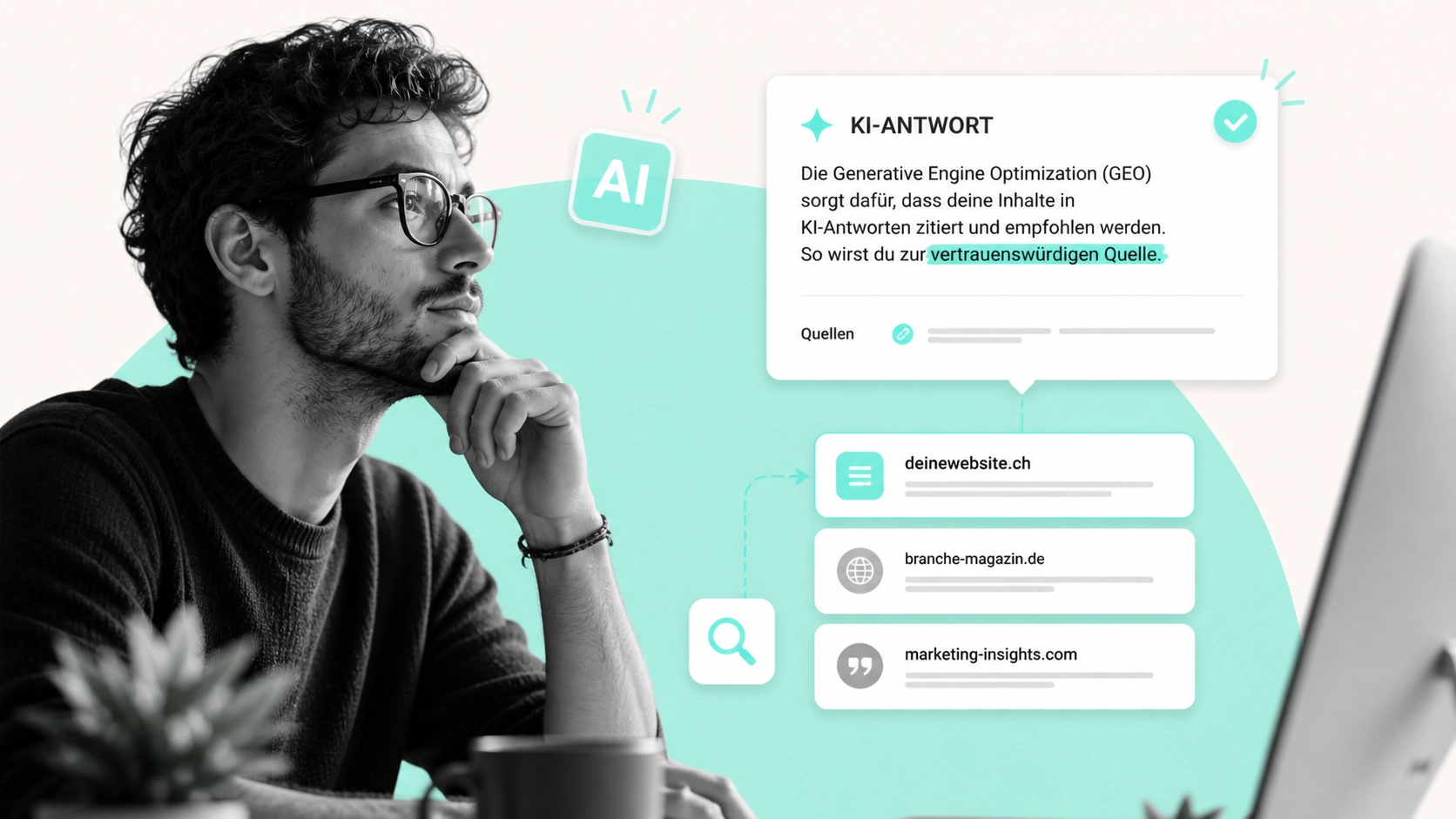
Google is changing faster right now than over the last 20 years combined. Instead of a list of blue links, Google increasingly answers search queries directly with an AI-generated summary. And Google isn't alone: ChatGPT, Perplexity, Copilot and other AI assistants are increasingly used as search engines. If you don't appear in these answers, you lose visibility. Generative Engine Optimization (GEO) is the discipline designed to prevent exactly that.
GEO doesn't replace SEO. It extends it. Your content needs to be prepared so that AI systems recognise it as a trustworthy source and incorporate it into their answers. Clear answers, concrete data, structured content with schema markup and visible authorship are the key factors.
Reach and community: social media marketing
In Switzerland, over 7 million people use social networks (source: DataReportal 2025). Nearly 80% of internet users are active daily. Social media marketing goes far beyond running ads: it's about building a genuine connection with your target audience.
The choice of platform determines success. LinkedIn suits B2B, recruiting and thought leadership (over 4 million Swiss users). Instagram suits visual storytelling, particularly strong in lifestyle, hospitality and trades. TikTok suits younger audiences with high organic reach. Facebook remains relevant for local businesses and community building.
⚠️ Common mistake
The biggest mistake: trying to be present on every platform at once without properly running any of them. It's better to consistently serve one or two channels with a clear content strategy. Consistency beats perfection.
Paid social media advertising offers extremely precise targeting by location, interests and behaviour. CPMs (cost per 1,000 impressions) in Switzerland typically range between CHF 8 and CHF 25.
Direct line to the customer: email marketing
With an average ROI of 36:1, email marketing delivers the highest return of all digital channels (source: Litmus, State of Email 2025). For every franc invested, an average of 36 comes back.
The most important formats: newsletters for regular updates. Automated sequences such as welcome emails, cart abandonment reminders and post-purchase series. And transactional emails, which achieve open rates of over 80%.
The key lies in segmentation. Segmented campaigns achieve on average 14% higher open rates and up to 100% higher click rates than unsegmented mass emails (source: Mailchimp).
Since the revised Data Protection Act (revFADP, in force since September 2023), Switzerland has had stricter requirements for consent and transparency. Double opt-in is mandatory.
Der Marketing-Funnel: Vom ersten Kontakt zum Kunden
Trust through recommendation: influencer marketing
Influencer marketing relies on the credibility of personalities trusted by their communities. Micro-influencers (1,000 to 50,000 followers) often achieve higher engagement rates than large accounts and are considerably cheaper.
Relevance matters more than reach. A food blogger with 5,000 engaged followers can be more valuable for a restaurant than a lifestyle account with 200,000. Tools such as HypeAuditor help identify fake followers.
The challenge lies in selection, contract drafting, campaign management and performance measurement. In Switzerland, disclosure requirements also apply to paid partnerships.
Automated and data-driven: programmatic advertising
Instead of booking ad space on a website as a flat package, with programmatic advertising you define a target audience. Algorithms find this audience in real time, no matter which website they happen to be on. The result: less wastage and more efficient use of budget.
Programmatic generally only pays off from a media budget of CHF 3,000 to CHF 5,000 per month. For smaller budgets, Google Display Ads and social media advertising are more efficient. The gradual phase-out of third-party cookies is fundamentally changing behaviour-based targeting. Contextual targeting and first-party data strategies are gaining importance.
Other disciplines at a glance
Mobile marketing
In Switzerland, around 45% of all internet page views came from smartphones in 2025 (source: StatCounter/Statista, September 2025). Mobile marketing covers app marketing, push notifications, location-based advertising and optimisation for mobile usage habits. Progressive Web Apps (PWAs) offer a cost-efficient alternative to native apps.
Video marketing
87% of companies already use video as a marketing tool (source: Wyzowl 2025). YouTube is the world's second-largest search engine after Google. Authentic short videos and tutorials often perform better on social media than elaborate image films.
Affiliate marketing
External partners (affiliates) promote your products and receive a commission per sale or lead. You only pay for actual results achieved. Particularly attractive for e-commerce businesses.
Voice search optimisation
Voice queries via Siri, Alexa and Google Assistant are longer, more naturally phrased and often locally oriented. For businesses with a local focus, it's worth optimising for FAQ formats and structured data.
Chatbots and AI in customer dialogue
AI-powered chatbots offer personalised support around the clock. For SMEs, hybrid solutions work well: simple queries are automated, more complex requests are forwarded to staff.
Welcher Kanal passt zu welchem Ziel?
Which channels are right for your company?
The answer depends on three factors.
Where is your target audience? A B2B company will have more success on LinkedIn than on TikTok. A local restaurant benefits more from Google Business and Instagram than from programmatic advertising.
What's your goal? Fast visibility requires SEA or social ads. Long-term organic traffic comes through SEO and content. Community building works through social media. Direct sales through email marketing and retargeting.
What's your budget? Start with the measures that have the biggest leverage and expand step by step.
🔗 Channels working together
The combination makes the difference. SEA delivers quick data on keywords and demand, which you use for SEO. Social media spreads blog content and generates backlinks. Email marketing converts the visitors coming through SEO and social media. Every channel reinforces the others.
The biggest challenge for SMEs is rarely which channel is right. It's implementation. Every discipline has its own tools, its own best practices and its own pitfalls. Those who try to do everything themselves spread their resources too thin. Those who work with specialised providers in a targeted way can focus on their core business and get the expertise that makes the difference between wasted budget and profitable growth.