


Most Swiss SMEs make decisions about products, pricing and markets based on experience, gut feeling and whatever sales tells them. That works fine as long as little changes. The moment a new competitor appears, demand drops or a product launch flops, something is suddenly missing: solid knowledge of what customers actually think, want and do.
Market research provides exactly that knowledge. Systematic, methodically sound and tailored to your organisation. It shows you who your customers really are, why they buy or don't buy, how your market is developing and where your biggest opportunities lie.
This guide provides an overview of the most important methods and applications of market research. You'll learn what type of research you need in which situation, what it costs and where the limits of do-it-yourself research lie.
What market research is and why it matters for SMEs
Market research is the systematic collection, analysis and interpretation of data about markets, customers and competitors. That sounds like big-corporation vocabulary. It isn't. Any organisation that makes decisions about products, prices, markets or target groups is essentially already doing some form of market research. Usually just unsystematically.
The difference between gut feeling and professional market research lies in the methodology. Gut feeling is based on personal experience, selective perception and individual customer conversations. Professional market research is based on structured data collection, defined samples and traceable analysis. One doesn't replace the other. But one can validate the other.
Market research is particularly relevant for Swiss SMEs because the Swiss market has specific characteristics: multilingualism (German, French, Italian), high purchasing power, competition that's manageable by international comparison but fiercely contested, and consumer behaviour that can't simply be derived from German or Austrian data. What works in Munich doesn't automatically work in Zürich. Those who work with Swiss data instead of imported assumptions make better decisions.
The two basic types: quantitative and qualitative
Market research can fundamentally be divided into two approaches. Both have their strengths, their limits and their typical applications. In practice, they complement each other.
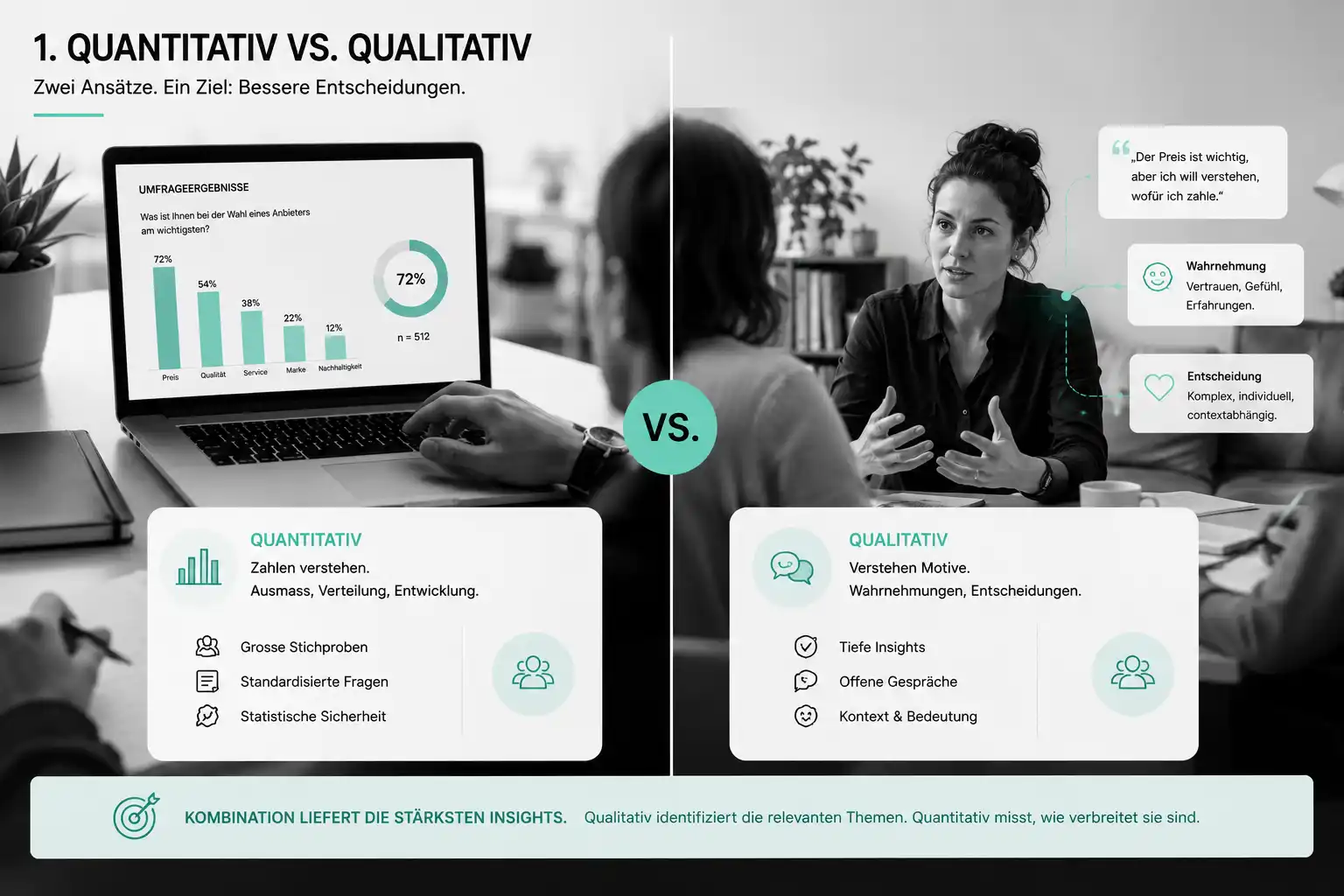
Quantitative market research
Quantitative research works with numbers. Large samples, standardised questionnaires, statistical evaluation. It answers questions like: How many customers prefer product A over product B? What's the willingness to pay for a specific service? How has brand awareness developed over the past year?
The strength of quantitative research lies in generalisability. If you survey 500 people from your target group and 72% say price is the most important purchasing criterion, you can transfer that to the overall population with statistical confidence.
The weakness: quantitative data shows the what, but not the why. You know that 72% mention price. But you don't know whether they mean the absolute amount, the price-performance ratio, or whether "price" is simply the socially acceptable answer because no one wants to admit they buy on impulse.
Typical quantitative methods: online surveys, telephone surveys, standardised questionnaires, A/B tests, conjoint analyses and tracking studies.
Costs in Switzerland: a simple online survey with 300 to 500 participants costs between CHF 5'000 and CHF 15'000. Larger studies with a more complex design range from CHF 20'000 to CHF 50'000.
Qualitative market research
Qualitative research works with words, stories and observations. Small samples, open conversations, interpretive analysis. It answers questions like: Why do customers buy from us? What do they feel when visiting our website? What needs do they have that they can't clearly articulate themselves?
The strength of qualitative research lies in depth. A one-hour in-depth interview with a customer can yield more strategically relevant insights than a survey with 1'000 participants. Because you don't just hear what the customer says, you understand why they say it and in what context.
The weakness: qualitative results aren't statistically representative. If 8 out of 12 interview partners mention a particular motive, that's a strong signal. But not a figure you can extrapolate 1:1 to the entire market.
Typical qualitative methods: in-depth interviews, focus groups, ethnographic observation, customer labs, insight sprints and narrative analysis.
Costs in Switzerland: individual in-depth interviews cost between CHF 500 and CHF 1'500 per interview including evaluation. A complete project with 10 to 15 interviews ranges from CHF 15'000 to CHF 40'000.
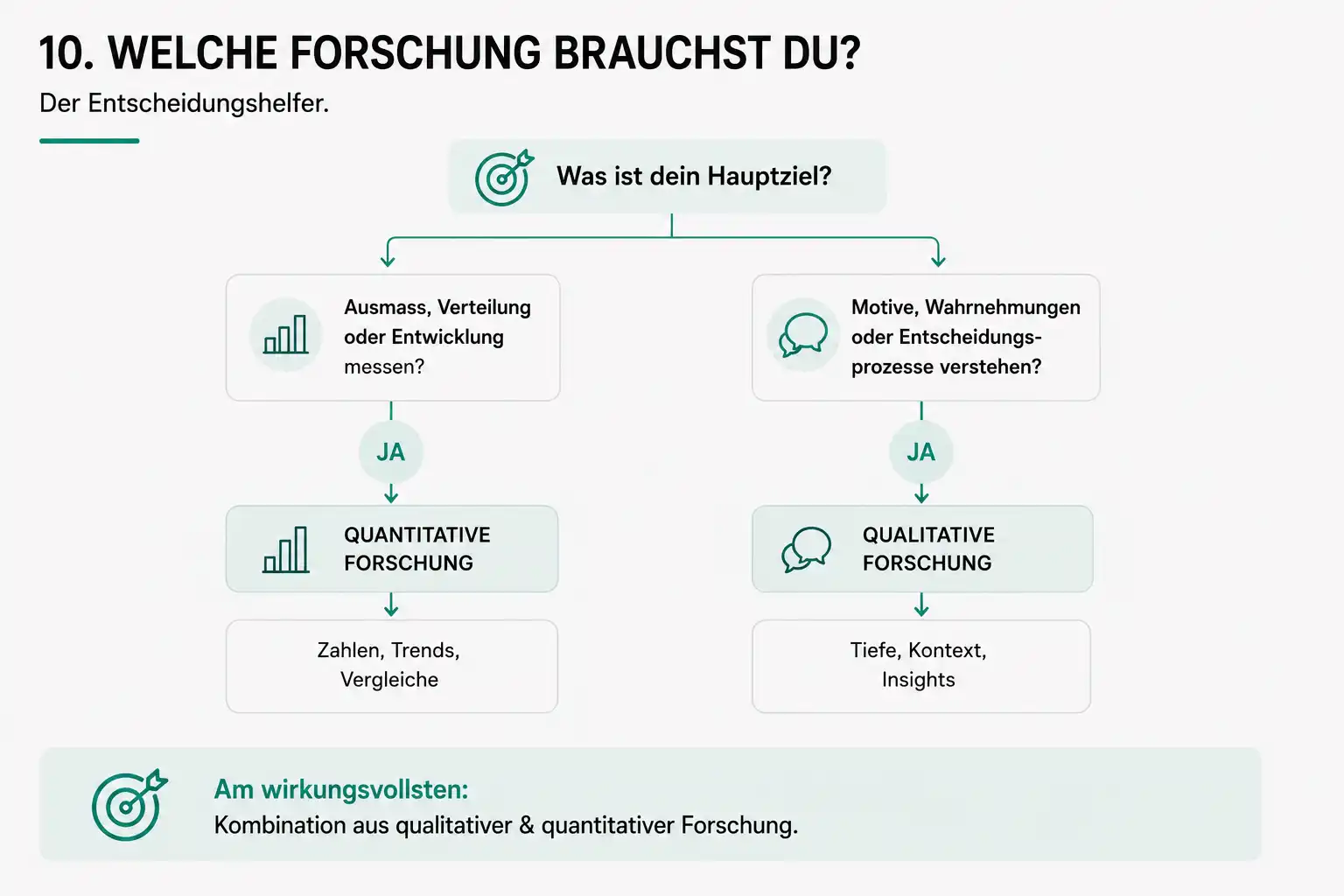
When do you need which? Quantitative, when you want to measure scale, distribution or development. Qualitative, when you want to understand motives, perceptions or decision-making processes. The combination is most effective: qualitative research identifies the relevant themes. Quantitative research measures how widespread they are.
→ In-depth article: Why organisations don't understand their customers
The most important applications
Market research isn't an end in itself. It becomes valuable when it answers a concrete business question. Below are the seven areas where market research has the greatest impact.
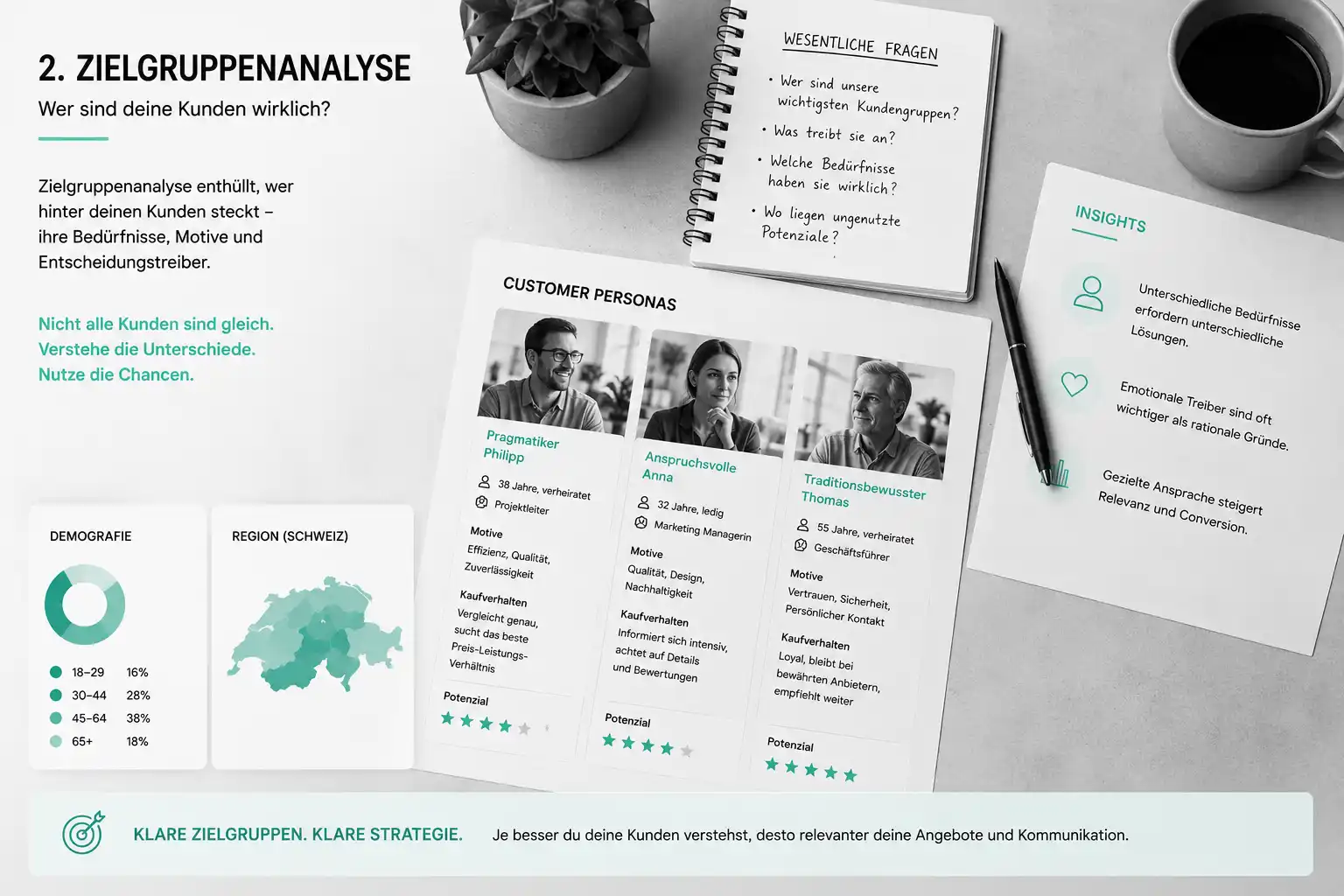
Target group analysis: Who are you really reaching?
Target group analysis is the starting point of every marketing strategy. It answers the question of who your customers are, how they think, and what they expect from you.
Many SMEs define their target group based on demographic characteristics: age, gender, income, region. That's a start, but it's not enough. Two 45-year-old men from Zürich with similar incomes can have completely different purchasing motives. One buys your product out of convenience, another out of conviction, and a third not at all, despite fitting the demographic profile perfectly.
A well-founded target group analysis goes deeper: What needs does your target group have? What problems are they trying to solve? Where do they get information? How do they make purchasing decisions? Who influences these decisions? What values matter to them?
Methods range from quantitative surveys (to identify and quantify segments) to qualitative interviews (to understand motives and decision logic) to analysis of existing data from CRM, web analytics and social media.
In Switzerland, there's an additional factor: the language regions differ not only in language but also in consumer behaviour, media habits and cultural expectations. A target group analysis that only covers German-speaking Switzerland may be worthless for Suisse romande.
Competitive analysis: Who is taking market share from you?
Competitive analysis shows you where you stand compared to your competitors. Not just in terms of price and product features, but also in terms of positioning, brand perception and customer satisfaction.
A common trap: organisations only analyse the competitors they already know. The obvious ones, active in the same industry. But the most dangerous competitors are often the ones not on your radar. A trust and fiduciary office competes not only with other trust offices, but also with accounting software, freelancers on platforms, and the brother-in-law's tax advisor.
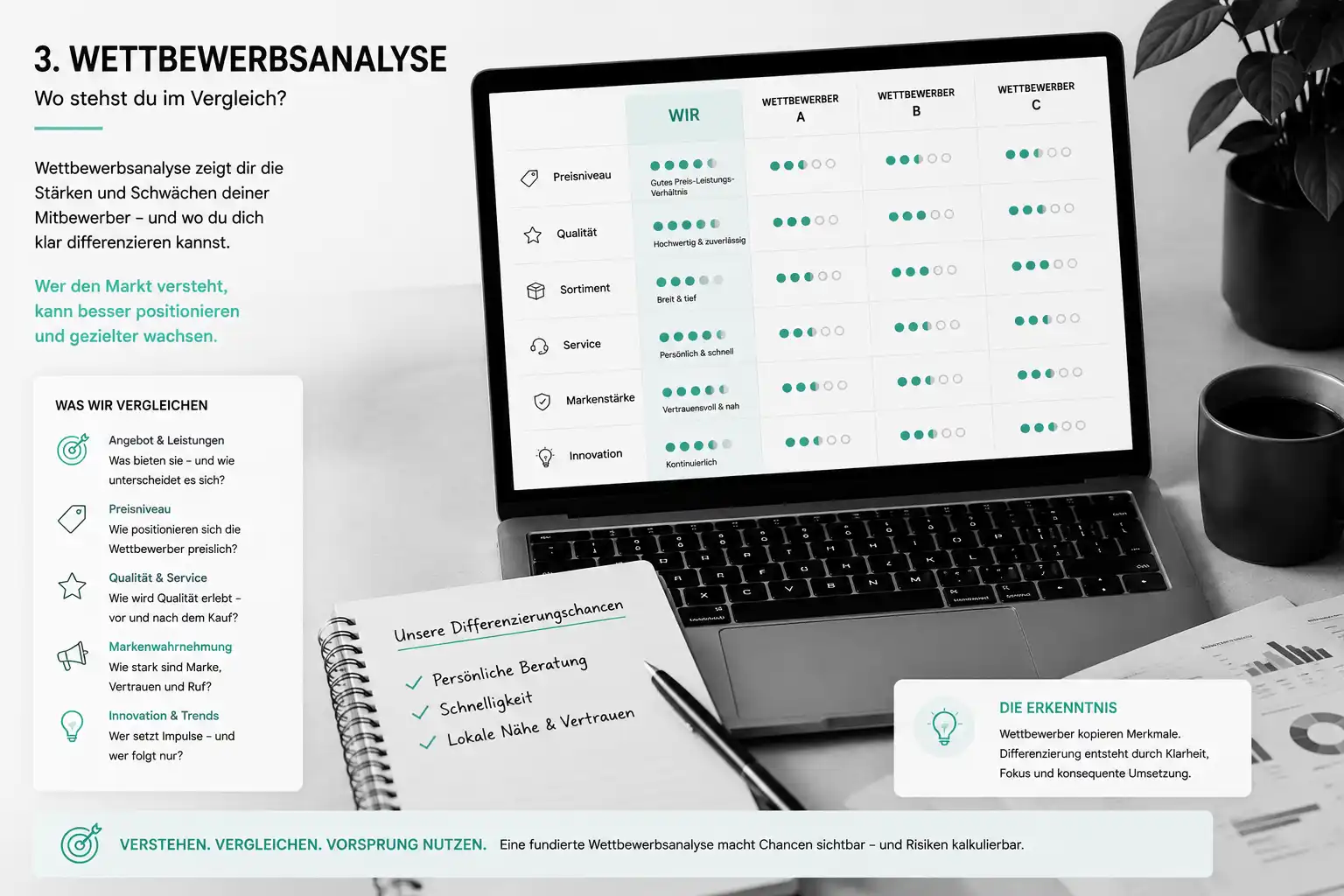
Good competitive analyses combine desk research (publicly available data, websites, price lists, annual reports) with the customer perspective (how do your customers perceive the alternatives?) and market data (market shares, growth rates, trends). The result isn't simply a table with strengths and weaknesses, but an understanding of why customers choose you or choose against you.
In a market as compact as Switzerland, a careful competitive analysis can reveal niches and positioning gaps that would be invisible in larger markets.
Market segmentation: Dividing the market into manageable pieces
Market segmentation divides an overall market into homogeneous groups that differ in their needs, behaviour or characteristics. Instead of addressing the entire market with a single message, you target your offering specifically at the segments most attractive to your organisation.
The classic segmentation criteria (demographics, geography) are increasingly being supplemented today by behaviour-based and needs-based approaches. The most interesting question isn't "How old are our customers?" but "What problem are they trying to solve?" (keyword: Jobs to be Done).
For Swiss SMEs, segmentation can also be quite pragmatic: which customer group generates the highest contribution margin? Which is easiest to reach? Which has the greatest growth potential? The answers determine where you deploy your marketing budget.
Segmentation usually requires a combination of quantitative research (to define the segments statistically) and qualitative research (to understand the segments in substance and translate them into personas).
Consumer analysis: How customers really decide
Consumer analysis examines the actual purchasing and usage behaviour of your target group. Not what customers say they do. What they actually do.
That's an important distinction. In surveys, people state that sustainability matters to them. At the supermarket, they still reach for the cheaper product. In interviews, they say they compare prices. In reality, they buy from the provider they find first. This discrepancy between statement and behaviour is one of the reasons why market research needs more than just surveys.
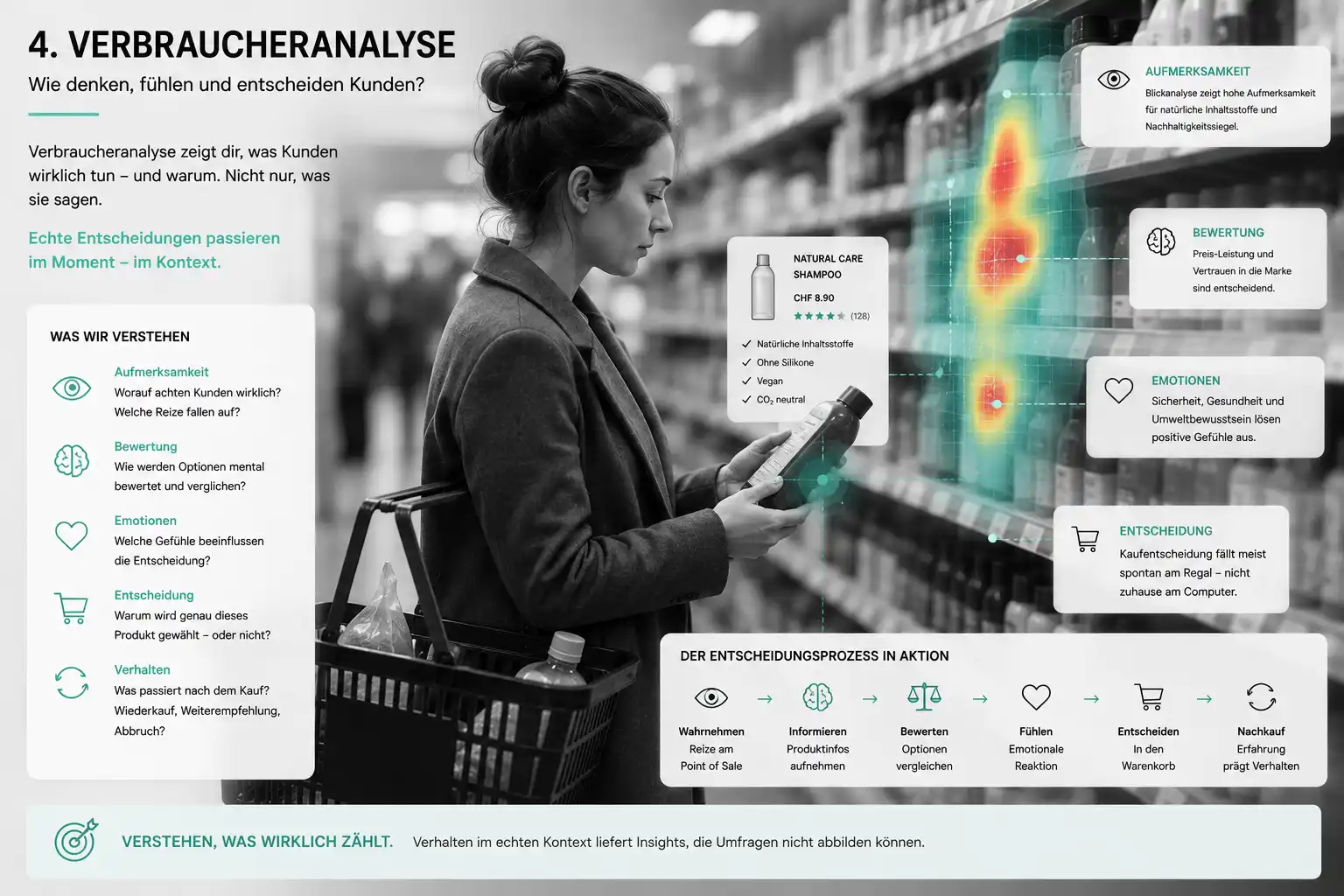
Consumer analyses use a broad range of methods: purchase data analysis, observation in-store or online (session recording, heatmaps), ethnographic studies (researchers accompany consumers in their daily lives), and experimental designs (e.g. conjoint analyses that measure willingness to pay for different product features).
For SMEs with their own online shop, analysing existing data (purchase history, shopping cart analysis, abandonment rates) already provides valuable insights before a single franc is spent on external research.
Product tests and focus groups: Before you launch
Product tests and focus groups are typically used before a market launch. They answer the question: How does the target group react to my new product, my new concept or my new packaging?
A product test has real users try out a product and gives structured feedback: comprehensibility, user experience, price acceptance, purchase intent. This can happen physically (tasting, hands-on testing) or digitally (prototypes, mockups, click-dummies).
Focus groups bring together 6 to 10 people from the target group to discuss a topic under moderation. The strength lies in group dynamics: participants react to each other, build on ideas and bring in perspectives that wouldn't have emerged in individual interviews. The weakness: peer pressure can lead to conformist behaviour. Individual dominant participants can distort the result.
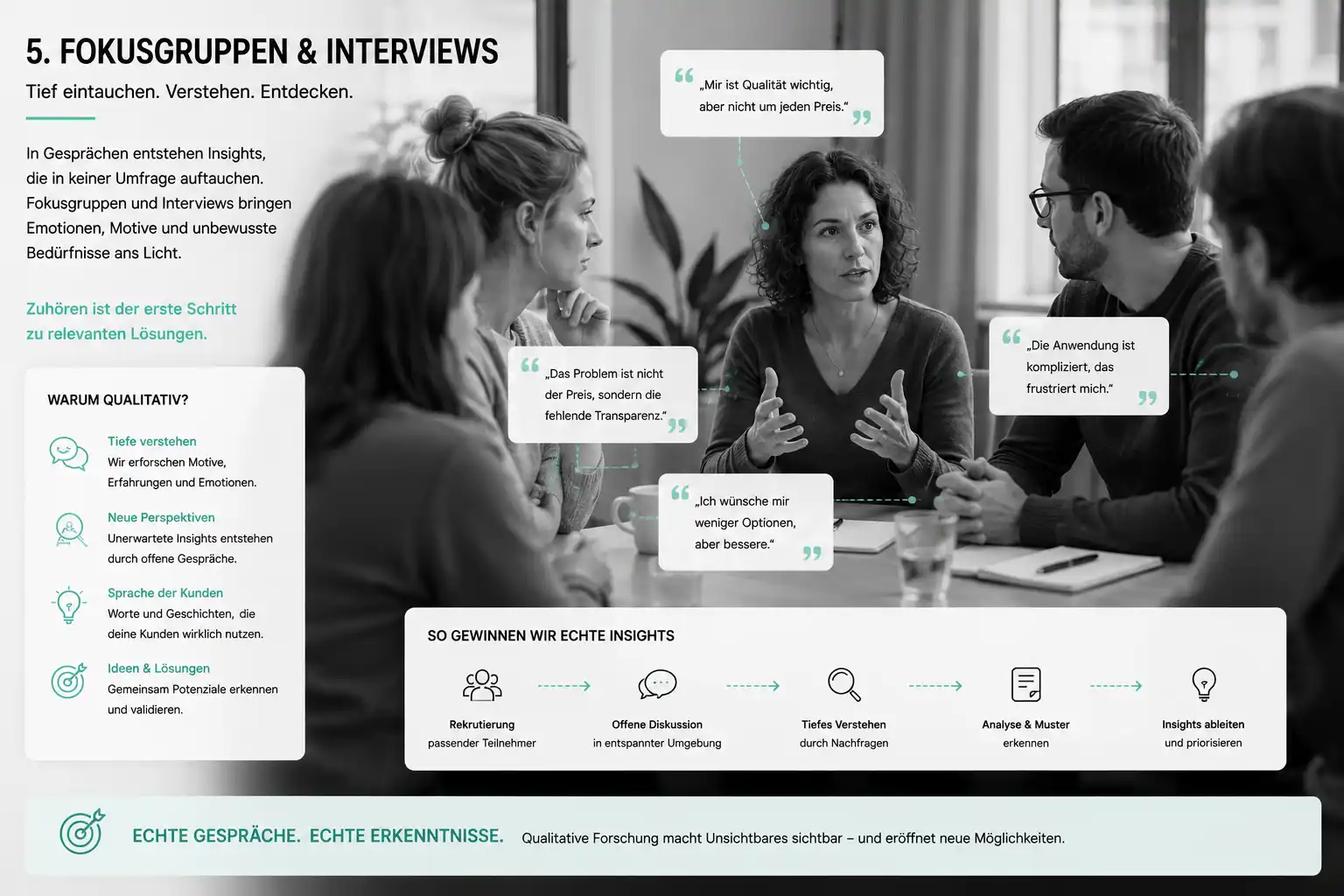
In Switzerland, focus groups are particularly revealing for multilingual products. Reactions to a product name, a slogan or packaging can differ fundamentally between German, French and Italian.
Costs in Switzerland: a single product test with 30 to 50 participants ranges from CHF 8'000 to CHF 20'000. A moderated focus group costs between CHF 3'000 and CHF 8'000 per session (recruitment, moderation, evaluation).
Opinion surveys: What your target group thinks
Opinion surveys capture attitudes, satisfaction, awareness or preferences of a defined target group. They're the workhorse of quantitative market research.
Typical applications: customer satisfaction measurement (CSAT, NPS), brand awareness and image tracking, employee surveys, price sensitivity measurement, and political or social opinion research.
The quality of a survey stands or falls with the questionnaire design and the sample. Poorly formulated questions produce worthless answers. A non-representative sample produces distorted results. Both happen more often than most clients suspect.
An example: you ask your customers "Are you satisfied with our service?" and offer a scale from 1 to 5. 78% give a 4 or 5. You conclude that everything is going well. What you don't see: you only surveyed customers who are still customers. The dissatisfied ones left long ago. And "satisfied" doesn't mean "loyal". It just means "no acute reason to switch".
Professional surveys account for such biases and are designed to deliver robust, actionable results. For an SME conducting a customer survey for the first time, working with an experienced service provider can make the difference between a confirmation exercise and genuine insights.
Trend analyses: What's coming your way?
Trend analyses identify developments in your market before they become mainstream. They help you make strategic decisions not based on today's situation, but on where the market is heading.
Trend analyses combine various data sources: industry reports (e.g. from GfK, Statista, the Federal Statistical Office), media analysis (which topics are gaining attention?), social listening (what is your target group discussing online?), expert surveys and patent analyses.
For SMEs, the biggest danger with trend analyses is jumping on every trend currently making the rounds in trade press. Not every global trend is relevant to your business. The art lies in identifying the trends that actually mean a change for your specific industry, your specific target group and your specific market.
Regular, even simple trend monitoring (quarterly, 2 to 3 hours) can already help avoid strategic surprises. For in-depth analyses with forecasts and scenarios, it's worth working with a research partner who has access to industry data and the analytical expertise required.
The most common market research mistakes
Getting involved too late in the process
In many organisations, market research is only considered once a problem has already occurred. The product isn't selling. The campaign isn't landing. Customer churn is rising. At that point, market research is damage control. Those who use it before product development, before market entry or before a campaign prevent problems instead of diagnosing them.
Asking the wrong questions
"Would you buy this product?" is one of the most popular and simultaneously most useless questions in market research. People are poor at predicting their own future behaviour. The better question: "Tell me about the last time you had a similar problem. What did you do?"
Ignoring results that don't fit the strategy
It happens regularly that market research results are ignored or reinterpreted because they don't confirm what management has already decided. Research shows the planned price increase won't be accepted by the target group? Then the methodology must be wrong. This pattern is so widespread that research has its own name for it: confirmation bias.
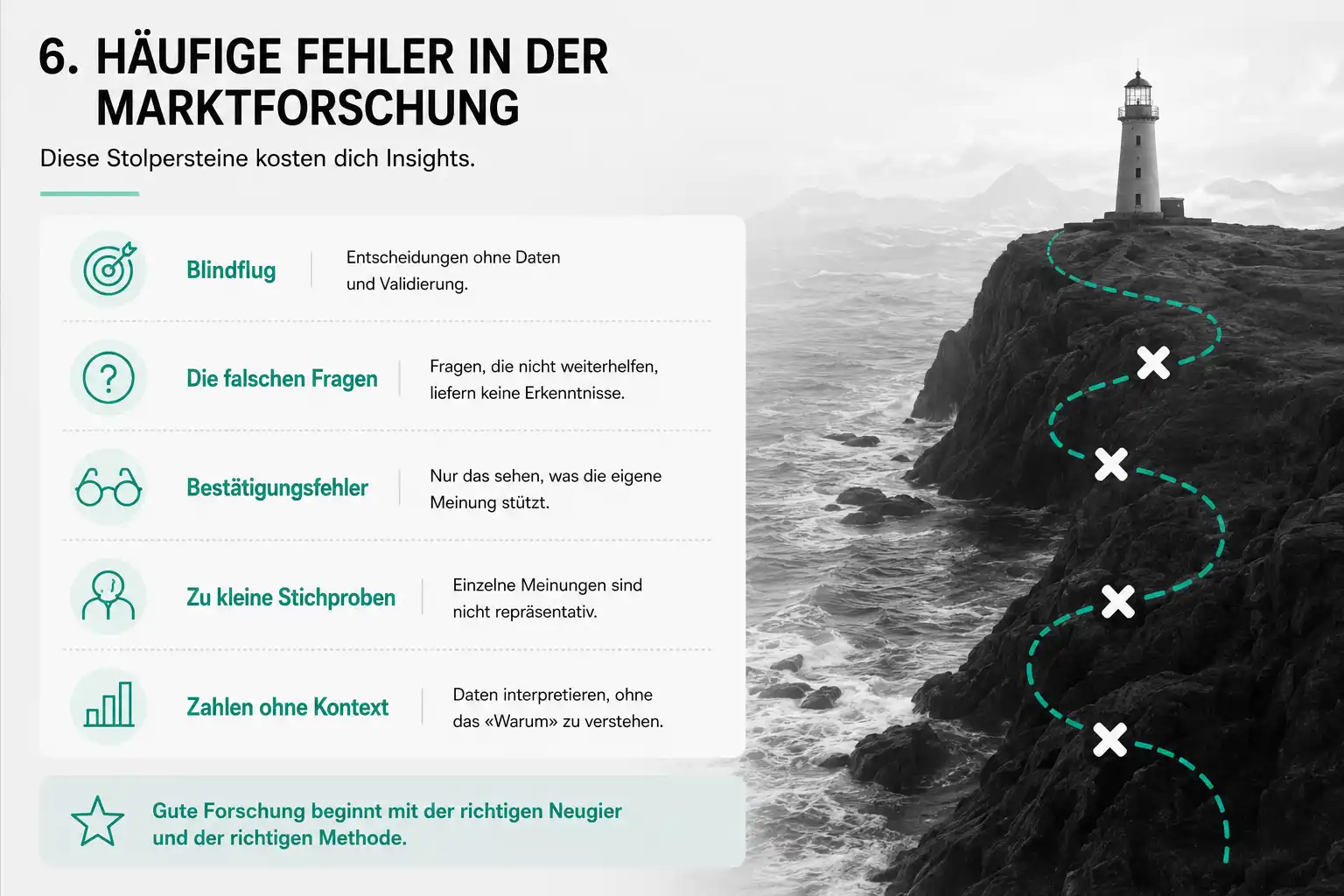
Researching once and never again
Markets change. Customers change. Competitors change. A target group analysis from 2020 may be outdated by 2025. Market research isn't a one-off project, but an ongoing process. The frequency depends on how dynamic your market is. But you should check at least once a year whether your assumptions about customers and market still hold true.
Too little budget for the wrong method
CHF 3'000 for a "representative study" with 50 participants isn't a good deal. It's a study that isn't representative and is treated as if it were anyway. Better: realistically assess the budget and choose the method that actually delivers robust results with that budget. Sometimes 10 good in-depth interviews are worth more than 200 hastily completed online questionnaires.
Do it yourself or bring in professionals?
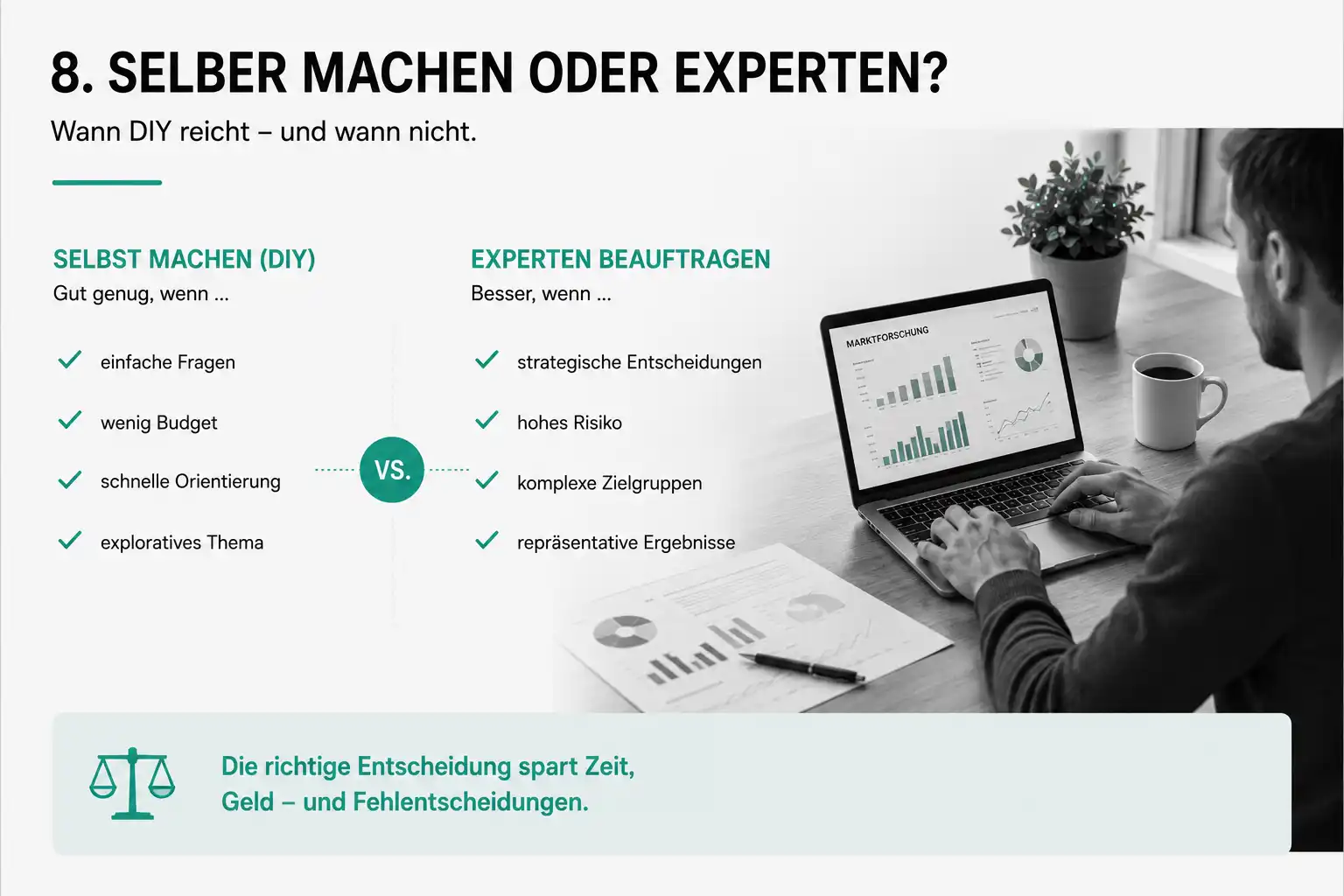
As an SME, there's a lot in market research you can do yourself. Other things, not so much. The line isn't drawn at company size, but at methodological expertise and available time.
What you can do yourself
Analysis of existing data: your CRM, your web analytics, your sales figures already contain valuable insights. Most SMEs don't come close to exhausting this data. An afternoon with Google Analytics or your shop backend can be more revealing than many a paid study.
Simple customer surveys: a short online questionnaire with 10 questions, sent to your existing customers, provides quick feedback. Tools like Google Forms or Typeform are free or inexpensive. Important: keep the questionnaire short, ask open questions, and be aware that you're only reaching existing customers.
Competitor monitoring: regularly observing your competitors' websites, social media presence, prices and reviews isn't rocket science and continuously delivers usable insights.
Informal customer conversations: every conversation with a customer is mini-research, provided you ask the right questions and systematically record what you hear.
Where professional support makes the difference
Study design and questionnaire development: a poorly designed questionnaire delivers distorted results, which are worse than no results at all. Because they create a false sense of certainty where none exists. Developing a methodically sound survey instrument requires expertise.
Recruiting participants: finding the right people for interviews or focus groups is labour-intensive. Specialised service providers have access to panels and recruitment networks that an SME doesn't have.
Qualitative analysis: conducting an in-depth interview is one thing. Systematically analysing the results from 12 interviews, recognising patterns and deriving strategic recommendations is another. That requires interpretive skill and experience.
International or multilingual research: research across language borders (a common case in Switzerland) requires not just translation, but cultural adaptation of the methodology. Questions that work in German-speaking Switzerland may be understood differently in Suisse romande.
Objectivity: when you research what your own customers think about your own product yourself, objectivity is a challenge. An external research partner has no agenda and no blind spot.
The decision between doing it yourself and outsourcing isn't an either-or question. Many SMEs start with in-house research, run into questions they can't answer on their own, and then bring in targeted professional support. This hybrid approach is often the most efficient path.
What market research costs and what it saves
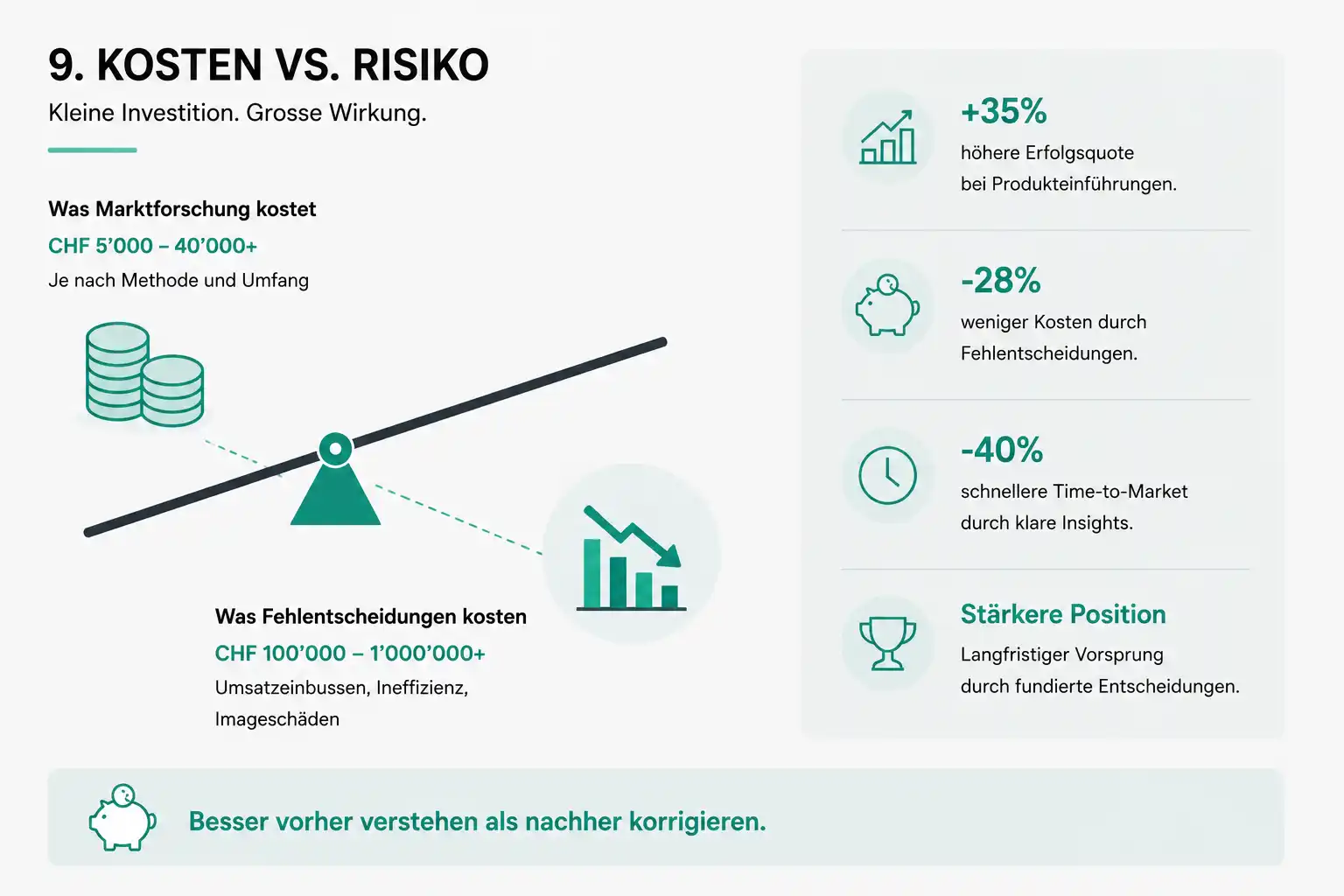
Market research is an investment. Costs vary considerably depending on method, scope and provider. Here's a guide for the Swiss market:
Simple online survey (300 to 500 participants): CHF 5'000 to CHF 15'000. Qualitative study (10 to 15 in-depth interviews): CHF 15'000 to CHF 40'000. Focus groups (2 to 3 sessions): CHF 8'000 to CHF 25'000. Comprehensive market study (combination of quantitative/qualitative): CHF 30'000 to CHF 80'000. Simple competitor monitoring (desk research): CHF 3'000 to CHF 8'000.
These figures are guideline values. For larger projects, international research or specialised methods, costs can be higher.
The more relevant question isn't what market research costs, but what it saves. A product launch that fails can quickly cost an SME CHF 50'000 to CHF 200'000 in development, marketing and lost time. A campaign that misses the target group burns through budget without showing any effect. A pricing strategy based on false assumptions costs margin every single day.
A product test for CHF 15'000 that prevents such a failure has paid for itself on day one.
AI and market research: What's changing
Artificial intelligence is changing market research. But differently than many think. AI doesn't replace research. It changes the tools.
What AI does well: analysing large amounts of data (text analysis of customer reviews, social listening, sentiment analysis). Recognising patterns in quantitative data. Personalising surveys and dynamically adapting questionnaires. Automatically generating and pre-structuring interview transcripts.
What AI can't do: survey real people. Recognise unconscious motives. Understand context. Read between the lines. Listen empathetically. And above all: generate new insights about specific target groups that aren't already contained in training data.
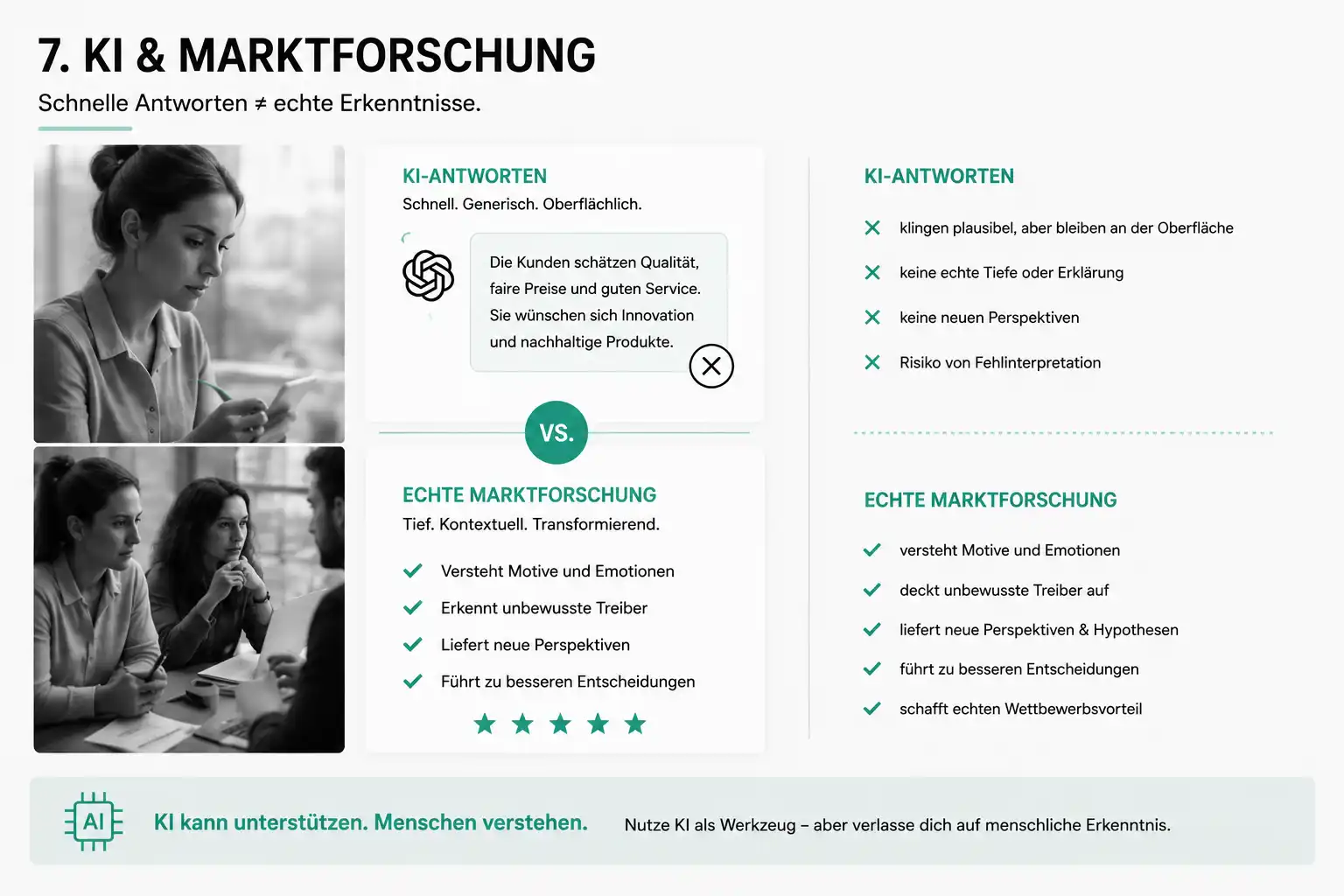
The danger: organisations that ask ChatGPT "Who is my target group?" and treat the answer as market research. AI-generated personas and target group descriptions are based on average knowledge from the internet. They reflect plausibility, not reality. It sounds convincing, but it isn't reliable.
The smart use of AI in market research: as a tool in analysis, not as a substitute for customer contact. The combination of real conversations with real people and AI-supported evaluation is more powerful than either approach alone.
What type of market research do you need?
The answer depends on your starting position.
Want to launch a new product? Start with qualitative interviews to understand needs and purchasing motives. Validate the findings with a quantitative product test. Run a focus group before launch to sharpen messaging and positioning.
Losing customers and don't know why? Combine an analysis of your existing data (churn patterns, complaints) with qualitative exit interviews. Often the reasons differ from what internal narratives suggest.
Want to expand into a new market? Start with a competitive analysis and market segmentation. Supplement with qualitative interviews in the target region to understand cultural particularities. In Switzerland, that often means: systematically examining Suisse romande or Ticino instead of translating the German-speaking Switzerland strategy.
Planning a price adjustment? A conjoint analysis or a Van Westendorp survey shows you your target group's willingness to pay. Without this data, any price change is a guessing game.
Want to reposition your brand? Brand image tracking shows how you're currently perceived. Qualitative research shows why. This creates the foundation for a repositioning based on genuine customer perspectives rather than internal wishful thinking.
In all these cases, the same rule applies: the choice of method determines the quality of the results. A wrongly chosen approach doesn't just deliver worse results, it delivers wrong ones. And wrong results treated as reliable are more dangerous than no research at all. This is exactly where the value of an experienced research partner lies: asking the right questions using the right methods of the right people.
On mmesh you'll find vetted market research specialists from Switzerland. Whether target group analysis, competitive analysis, product test or qualitative study: find the right service provider free of charge and without advertising-budget bias.