


Companies make daily decisions about products, brands and strategies with the aim of putting their customers first. Yet in practice, a structural problem keeps recurring: despite vast amounts of available data, these decisions are often not based on a deep understanding of people, but on assumptions, simplifications and systematic thinking errors.
Understanding experiences, meanings and decision-making processes is the central foundation for robust insights. We call this understanding «Human Understanding». It combines findings from psychology, social sciences and behavioural research with the practice of qualitative market research.
Three questions are at the centre of this: Why do companies believe they understand their customers, even though they often don't understand them deeply enough? How does genuine understanding of people actually emerge? And what role does qualitative market research play in this?
1. Flying blind and wasted reach: knowledge is not the same as understanding
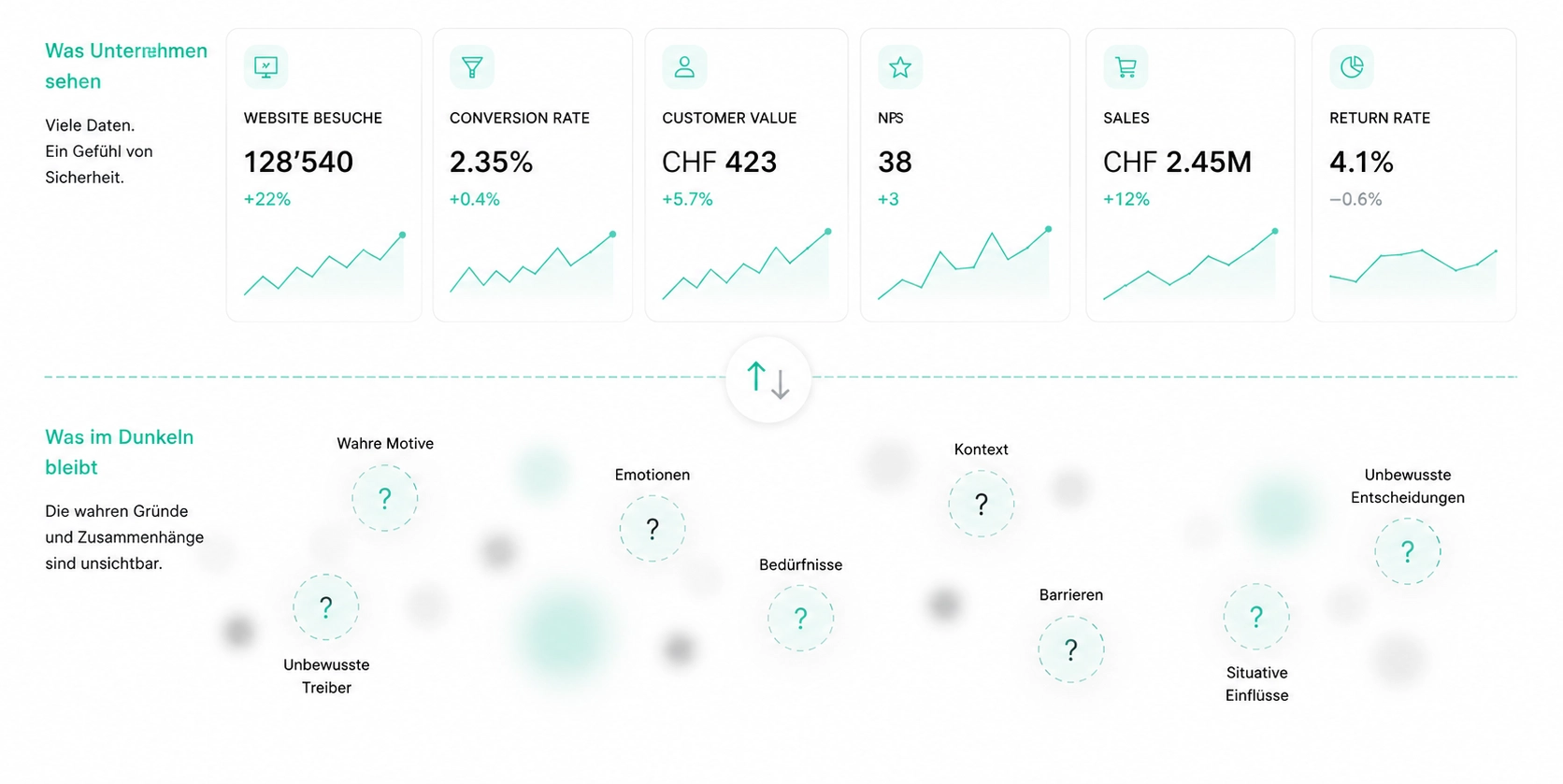
Many organisations implicitly assume they know their customers. They have market data, sales figures, CRM information and customer contacts through sales teams. This information creates a sense of security. But that sense is deceptive: despite the abundance of data, a blind spot remains. Many companies don't actually know how their customers tick, how they make decisions, or which drivers and barriers shape their behaviour. Understanding non-customers is even more challenging.
True motives remain in the dark
This lack of understanding of the «why» can lead to far-reaching problems in market activities. When the true motives of existing and potential customers remain unclear, customer messaging often degenerates into generic communication. The result is flying blind and wasted reach: companies invest in campaigns without knowing whether they reach their target audience emotionally. Or the customer journey remains a mystery, because it can only be partially decoded through superficial data points.
Classic marketing often assumes a conscious, rational consumer who happily talks about their wants and needs and makes deliberate purchasing decisions. But Blaise Pascal already suspected otherwise back in the 17th century, coining one of his best-known lines: «Le coeur a ses raisons que la raison ne connaît pas» («The heart has its reasons which reason does not know»).
Consumers decide unconsciously and justify their choices afterwards
Scientific research confirms this: consumers are often unaware of their own purchasing motives. Psychology and behavioural economics show that a large share of our decisions is made unconsciously. When consumers are asked about their motives in classic, standardised surveys, they tend towards «post-hoc rationalisation»: to reduce cognitive dissonance and justify their behaviour, they construct logical-sounding explanations after the fact for decisions that were originally driven by emotion and the unconscious.
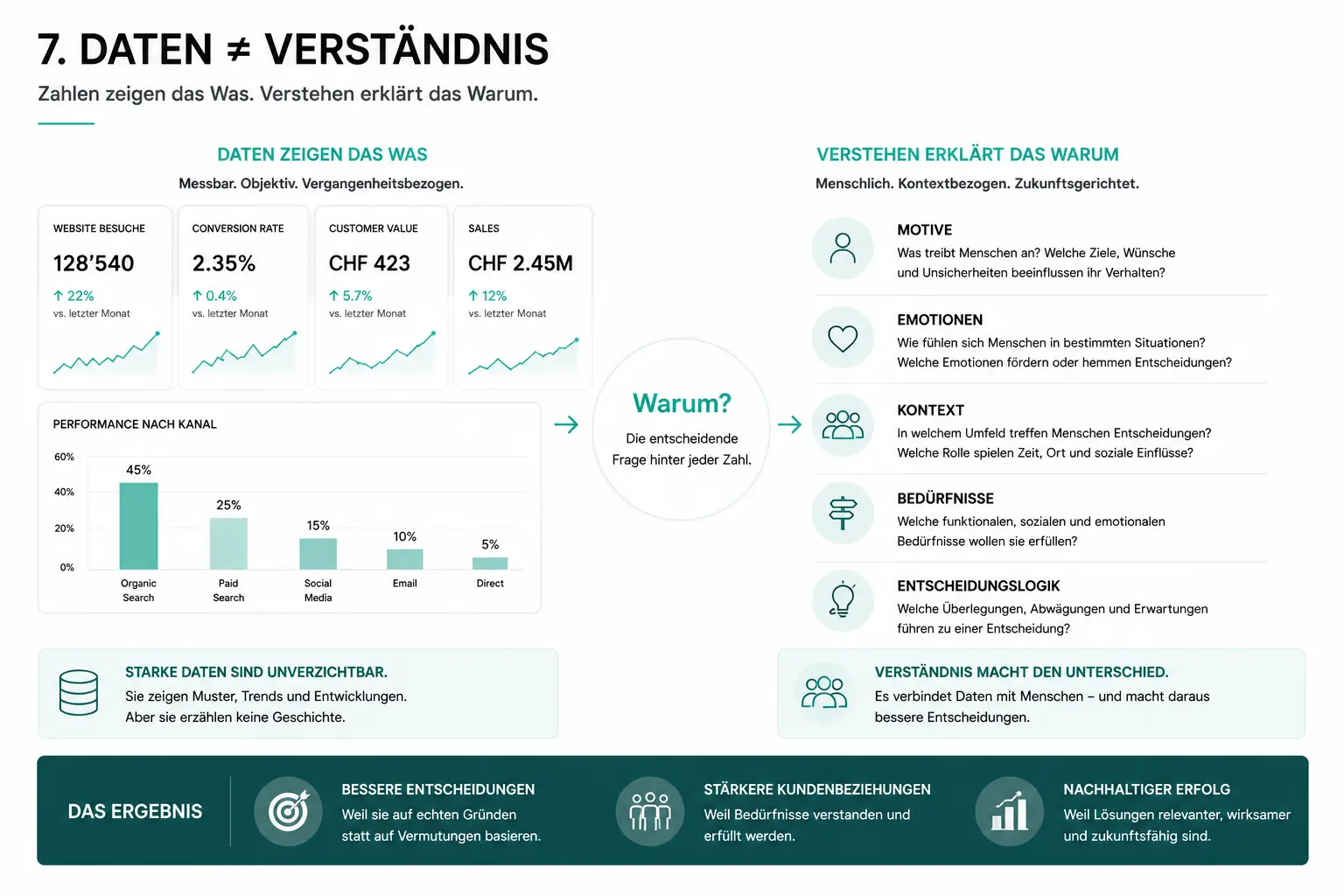
Sociologist Max Weber distinguished between explaining and understanding. While quantitative data can explain what happens in terms of frequencies and distributions, understanding aims to reveal why people act the way they do. This «why» is decisive: why is a product chosen despite a higher price? Why is a brand rejected despite objective advantages?
These questions cannot be answered by quantitative data alone. They require access to subjective experiences, attributed meanings and situational contexts.
2. The 12 costly fallacies in market research
The good news is that access to this subjective level of experience does exist. The bad news: companies use it far too rarely.
Forgoing in-depth research is rarely a conscious strategic choice. Rather, it results from a combination of psychological and organisational mechanisms that carry costly consequences.
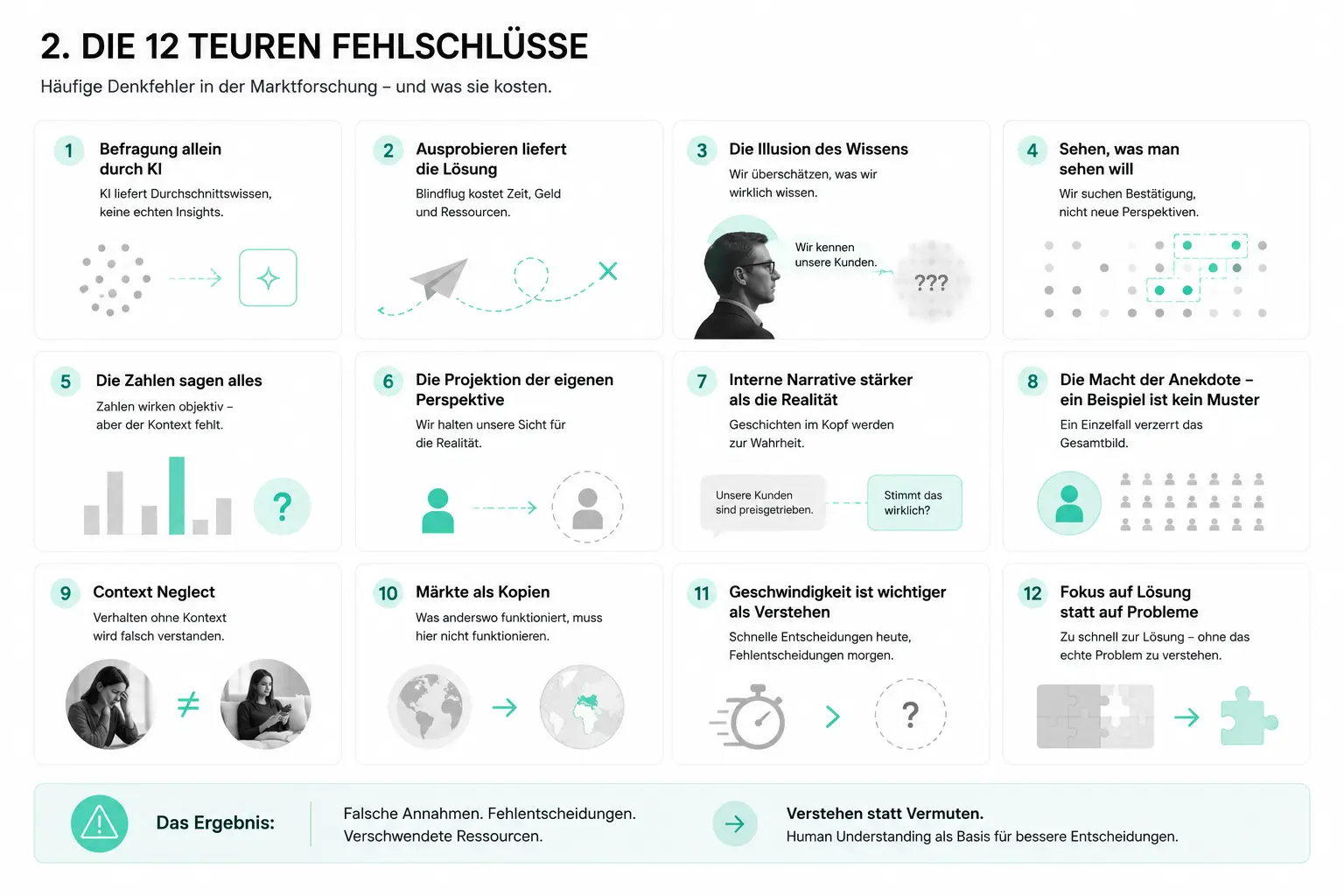
Below, without claiming to be exhaustive, we have compiled twelve common fallacies that companies often fall into when it comes to market research.
Fallacy 1: Relying on AI alone for answers
A currently popular approach is to simply ask artificial intelligence (AI). The fallacy here is the assumption that AI delivers well-founded answers to complex questions. In reality, however, AI merely generates aggregated average knowledge based on historical data. It does not provide genuine, deep, and above all no new, insights into specific target groups.
Fallacy 2: Trial and error will find the solution
Just try things out and see what works. This can, however, become an expensive exercise in flying blind — one that costs not only time and money, but potentially careers as well.
Decision-makers love data and facts. Yet when it comes to a deeper understanding of consumers, many companies forgo expanding their knowledge.
Fallacy 3: The illusion of knowledge
The so-called «overconfidence bias» describes the tendency to systematically overestimate one's own knowledge. This is particularly pronounced among experienced product managers, sales teams with frequent customer contact, and long-serving brand managers. In companies, this often shows up in statements such as «We've known our target audience for years» or «We talk to customers every day». These statements aren't wrong, but they are incomplete. Individual contacts cannot replace a systematic, representative understanding. They provide fragments, not structure.
Fallacy 4: Seeing what you want to see
The «confirmation bias» leads people to interpret information in ways that confirm existing assumptions. In concrete terms: data is read selectively, and conflicting signals are ignored. Research is used to confirm rather than to explore. This prevents exactly what qualitative research is meant to achieve: making new perspectives visible.
Fallacy 5: The numbers say it all
The «illusion of objectivity» names the problem directly: quantitative data appears objective and reliable, but actually requires interpretation. An interpretation bias arises because context is missing and motives remain invisible. As a result, the numbers are over-interpreted.
Fallacy 6: Projecting your own perspective
The «false consensus effect», or «substitution bias», describes the tendency to treat one's own point of view as universally valid. Internal perspectives are transferred onto customers, and decision-making logics within the company are assumed to be «normal». Instead of asking people, decision-makers answer the question themselves. The problem is that complex questions get replaced with simple ones, masking underlying uncertainties.
Fallacy 7: Internal narratives outweigh reality
Companies develop enduring «stories» about their customers, such as «Our customers are price-driven» or «Our brand stands for quality». Many of these assumptions arise from conversations about customers rather than conversations with them. These narratives are rarely questioned and risk shaping decisions more strongly than data or evidence.
Fallacy 8: The power of anecdote — one example is not a pattern
The «availability bias» causes easily recalled or striking examples to be given too much weight. Typical consequences: a single customer conversation gets generalised, and extreme cases shape the overall picture. This produces a distorted understanding of markets.
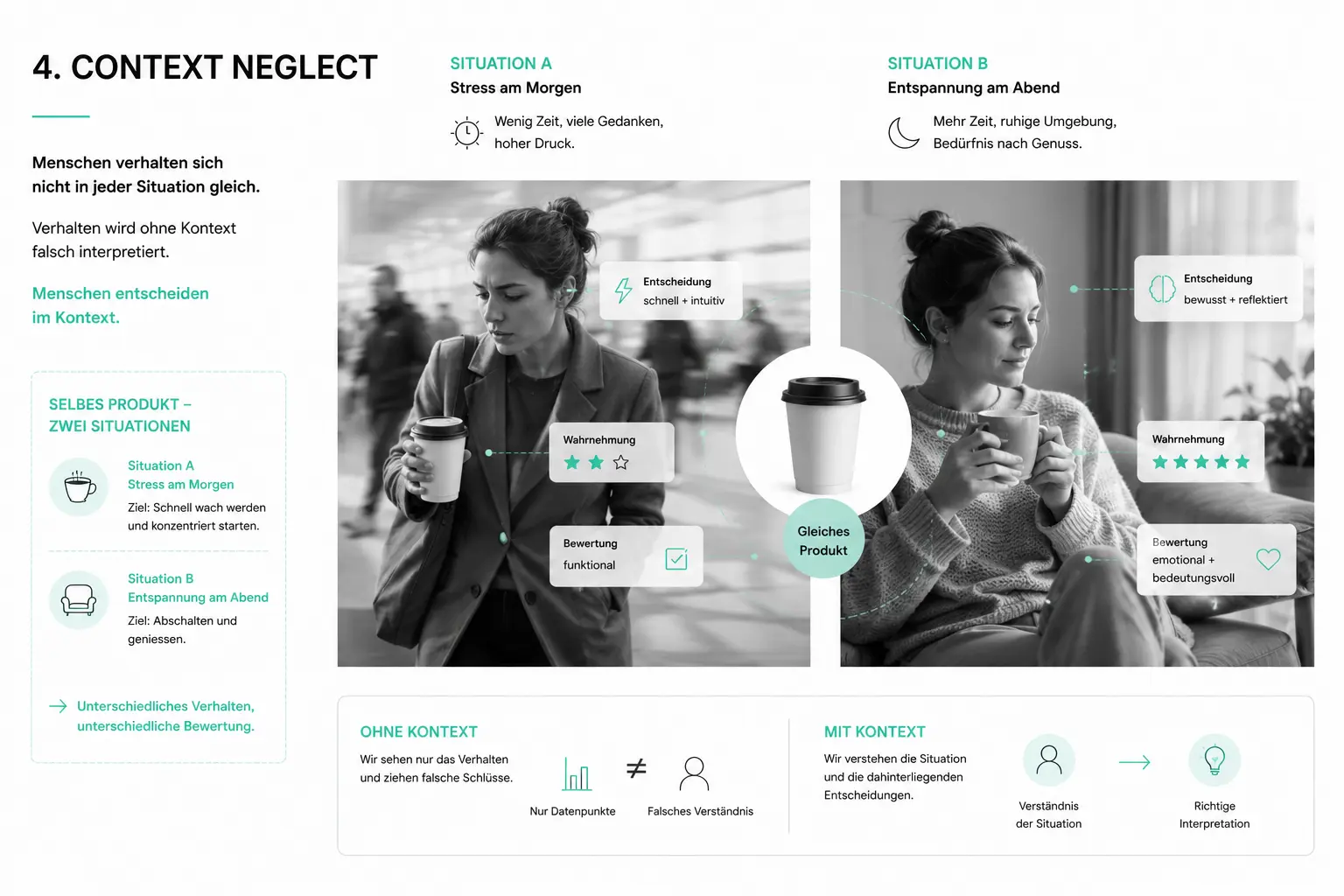
Fallacy 9: Context neglect (misunderstanding customer behaviour without context)
There's often an assumption that human behaviour is stable and consistent across different situations. But people behave differently depending on the context. Situational factors are frequently underestimated. Consumers make decisions within a context.
Fallacy 10: Markets as copies
The principle of cultural simplification («cultural evidence bias») is another relevant fallacy. In an international context, there's often an assumption that similar markets function similarly (for example, transferring findings from Germany to Switzerland). This assumption ignores the fact that markets differ not just structurally, but above all in meaning and cultural context. Products don't just serve functions — they carry meanings, and these are culturally shaped.
Fallacy 11: Speed matters more than understanding
In a fast-moving world, quick decisions are in demand. The pressure to decide quickly leads to exploration being seen as a delay and qualitative research being dismissed as too slow. Yet wrong decisions cost more time than deep understanding does.
Fallacy 12: Focusing on solutions instead of problems
Many companies jump to solutions too quickly («solution bias»). Critical questioning gets skipped, and customer needs are not truly understood. Good solutions, however, arise from a thorough understanding of the problem (keyword: «jobs to be done»).
3. The path to actionable understanding of your target audience: the principles of «Human Understanding»
The barriers described above share a common core: they reduce people to behaviour, data points or categories. What's missing is access to the level of human experience. Phenomenological sociology, as developed by Alfred Schütz, for instance, describes how people don't perceive their world objectively, but structure it through subjective meanings.
This means decisions are embedded in life contexts. Products carry personal meaning. Brands are part of identity and everyday life. Without access to this level, understanding remains superficial.
This is exactly where the «Human Understanding» approach comes in. «Human Understanding» means understanding how people interpret their experiences, make decisions and give meaning to their actions.
Understanding begins with storytelling, not with «why»
Asking directly «why» is omnipresent in market research and has long been considered a mantra of qualitative researchers (keyword: «laddering technique», descending an imaginary ladder towards true motives by repeatedly asking «why»).
Yet from a psychological perspective, asking «why» is problematic. Organisational psychologist Tasha Eurich found in her research on self-awareness that «why» questions don't lead people to deeper insights, but often trigger an unproductive thought loop (rumination). When we ask respondents, «Why don't you like this product?», we force them to find a rational explanation for what is often an irrational process. This leads to what's known as the «introspection illusion»: people mistakenly believe they have direct access to the origins of their mental states and decisions. In reality, they merely construct a plausible story that justifies their behaviour.
Philosopher Michael Polanyi coined the term «tacit knowledge» in this context and summed up the dilemma in a famous phrase: «We know more than we can tell». Consumers possess deep, intuitive knowledge about their needs and actions, but struggle to put it into words when asked directly.
It's also worth noting that asking «why» unconsciously puts people on the defensive, which influences how they respond. «Why» questions often trigger defensiveness, since they can sound accusatory, judgemental or like an interrogation, making people feel they need to justify their actions. This can cause people to close up or respond confrontationally instead of opening up.
If the «why» question leads us astray, how should we ask instead? The answer lies partly in the right moderation technique, and partly in context.
Alternative ways of asking «why» without using the word itself come from «elicitation techniques», where respondents are encouraged to keep talking through open questions (see below). Such prompts to narrate focus on context: people don't act in the abstract, but in concrete situations. That's why we first ask about the what and the how, and only then about the why.
What task needed to be accomplished? What was missing in the situation? What was tried? This approach draws strong inspiration from the «jobs-to-be-done» theory (JTBD) developed by Harvard professor Clayton Christensen. Christensen argues that consumers don't buy products because of their features or demographic fit. Rather, they «hire» a product to get a specific job done in a specific situation.
A famous example is Christensen's milkshake study: a fast-food chain wanted to boost milkshake sales. Traditional market research (focus groups, demographic analyses) produced no increase in sales at all. Only when researchers observed the context did the pattern emerge: nearly half of milkshakes were bought before 8 a.m. by commuters sitting alone in their cars. The «job» of the milkshake wasn't to be a dessert. Its job was to make a boring commute more interesting, occupy a free hand and keep people full until lunch. No demographic variable could have explained this behaviour — only understanding the concrete situation could.
This focus on context and practical action also resonates in philosophy. In his phenomenology, Martin Heidegger distinguished between things we merely regard theoretically («presence-at-hand») and things we use unconsciously and as a matter of course in our everyday actions («readiness-to-hand»). True understanding doesn't emerge from abstract questioning, but from analysing people's lived world and their concrete actions.
Understanding requires more than a single method
To capture human behaviour realistically, a single method is not enough. It requires combining insights from psychology, behavioural economics, neuromarketing, nudging and other approaches with a broad range of methods.
Behavioural economics, shaped significantly by Nobel laureate Daniel Kahneman, has shown that human thinking operates on two systems. System 1, the autopilot, is fast, automatic and emotional; System 2 is slow, effortful and logical. Classic market research addresses almost exclusively System 2. Yet most purchasing decisions are made by System 1. System 1 becomes more active the fewer resources are available — for example, time pressure while shopping, an overwhelming range of products, or products too complex to compare, and so on.
Active listening as the most important method in qualitative research
Conversations in which people don't just answer, but start to reflect and tell their story.
Active listening comes from humanistic psychology and is characterised by empathy, non-judgemental listening and understanding of the other person's perspective. For interview practice, this means asking open questions, mirroring statements and non-directive conversation techniques. Good research begins with genuine listening. Respondents should have most of the speaking time.
Discovering how people explain their world through stories
Stories often hold the real insights into needs, motives and barriers.
People structure their experiences into narratives. People explain their actions through stories. Narratives reveal structures of motivation, conflict and meaning. For interview practice, this means open prompts to narrate («elicitation»), few interruptions and analysis of narrative structure. During the conversation, people are given space to tell their experiences in their own words. Examples include questions such as: «Tell me more about that», «How did you arrive at this decision», «What influenced you».
This method bypasses conscious defence mechanisms and brings the true, often unconscious motives to light.
Understanding meanings and interpreting statements in context
Statements are never viewed in isolation, but always in the broader context of respondents' lived reality.
The aim is to experience the world radically from the consumer's perspective. The target audience's lived world is analysed and the subjective meaning that products or services hold for them is decoded. It's not about the product itself, but about the role it plays in the person's life.
The central idea of phenomenology is that people act based on their lived reality. Qualitative market research aims to understand this subjective perspective as undistorted as possible. For qualitative interviews, this means focusing on lived experience and subjective meanings, setting aside preconceptions, and listening openly to respondents' accounts of their experience. The guiding principle here is to be interested not only in what people say, but in how they experience their world.
Recognising patterns so that individual voices become insights
Hermeneutics deals with interpreting meaning in statements, texts and conversations. In the hermeneutic circle, understanding emerges through a continuous interplay between individual statements and the overall context. Statements are not interpreted in isolation, but in context. Meaning arises through dialogue between respondents and researchers, so that statements are understood in the context of biography, situation and culture.
Grounded theory is one of the most influential methods in qualitative social research. A theory emerges from the data, not the other way round, through iterative analysis and constant comparison of cases. Patterns and concepts are developed inductively from interviews. This is especially well-suited when exploratory insights are needed. Findings emerge from people's own voices — they are not forced into predefined categories.
The patterns identified form a reliable basis for strategic decisions. They transform previous guesswork into well-founded, evidence-based courses of action. Robust insights into people and markets emerge from individual conversations.
4. The myth of large numbers in qualitative market research
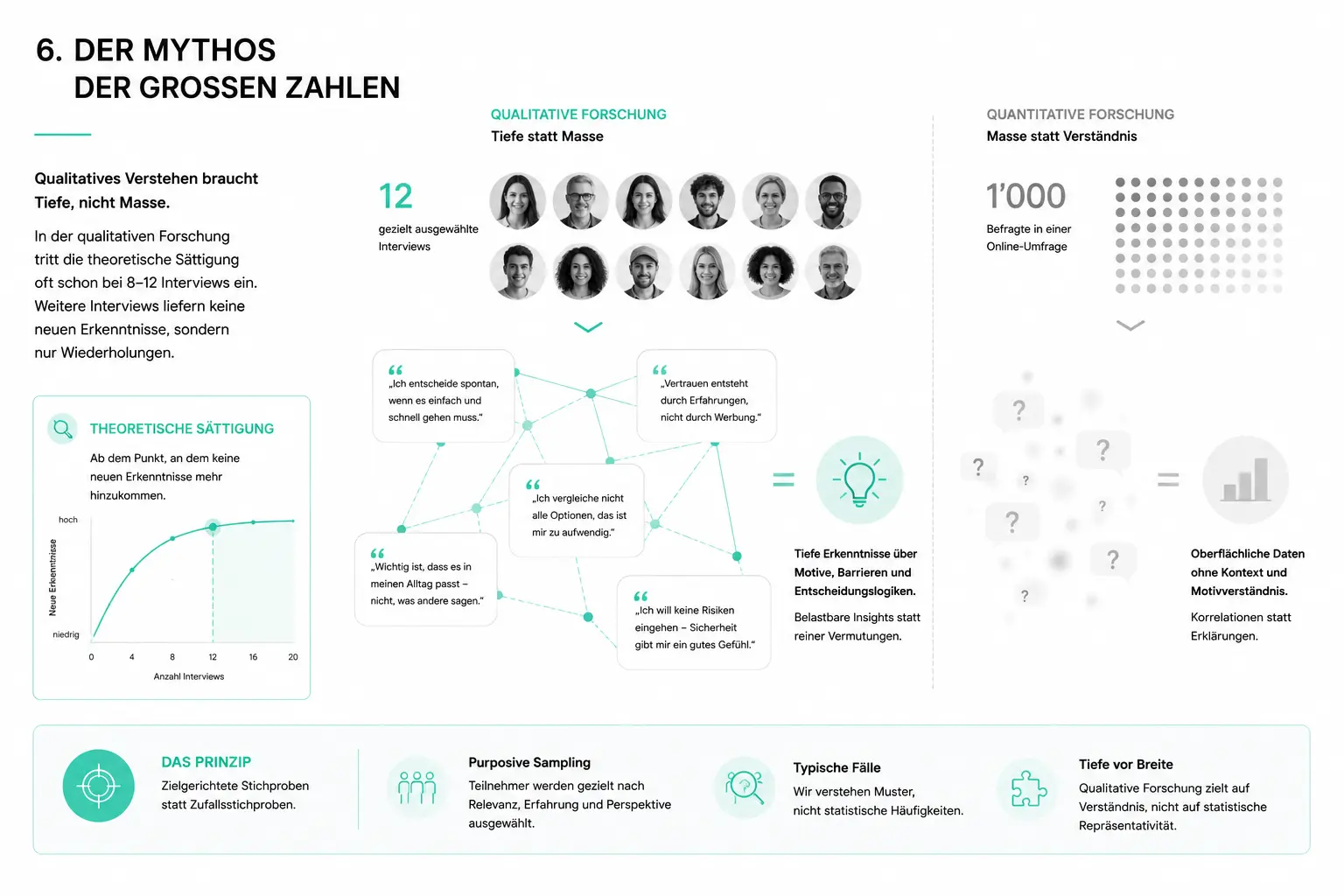
Finally, we'd like to address a common objection to qualitative market research: «Answers from just 10 respondents can't possibly be representative!» This objection rests on a fundamental misunderstanding of qualitative methodology.
Scientific research clearly shows that in qualitative research, so-called «theoretical saturation» is often reached after just 8 to 12 interviews. A base sample size of 12 corresponds to the number of participants typically needed to reach saturation within a homogeneous population. This means that beyond this point, further interviews no longer yield new fundamental insights, only repetitions of patterns already identified.
The misunderstanding lies in assuming that qualitative research must be statistically representative. That standard applies to quantitative research, which seeks representativeness through large, randomly selected samples.
Qualitative research, by contrast, relies on «purposive sampling». Purposive sampling is a non-probabilistic method in which researchers deliberately select participants based on specific characteristics, expertise or experience relevant to the study. It's frequently used in qualitative research to gain deep insights from information-rich cases, rather than aiming for statistical generalisability. The method is also used in exploratory approaches such as case studies or when targeting hard-to-reach niche audiences.
The focus here is on selecting typical representatives of the target audience to ensure social representativeness. Depending on the research question and objectives, homogeneous or heterogeneous subgroups can be formed. Common purposive sampling approaches don't rule out including extreme cases or expert interviews.
5. Conclusion: why «Human Understanding» is strategically relevant
A deep understanding of people is not a «nice to have». It is strategically decisive:
When decision-making logics are understood, offerings become better suited to needs, risks are assessed more accurately, and more relevant innovations emerge.
Many markets are functionally saturated. Differentiation comes from meaning, experience and perception. These dimensions can only be uncovered through qualitative methods.
Poor decisions don't stem from a lack of data, but from flawed assumptions. Human Understanding acts as a corrective here.
Qualitative research is the key instrument for systematically generating Human Understanding. It provides access to subjective perspectives, enables exploration of unfamiliar topics and supports understanding of complex decision-making processes.
Qualitative formats such as in-depth interviews, focus groups, insight sprints, customer labs or ethnographic studies create the necessary closeness to people. Quantitative methods then provide structure and comparability. Tools and methods are continuously reviewed and refined to reflect reality as precisely as possible. But they remain a means to an end. What matters is the experience needed to make the leap from data to meaning.
What matters most: methods are tools, but mindset is decisive. Good qualitative research is characterised by openness, interpretive skill and systematic analysis.
Understanding as a competitive advantage
Companies operate in increasingly complex markets. Data is available; understanding is not. The central challenge isn't gathering more information, but understanding customers better. Human Understanding offers a structured approach for this — through listening, understanding stories, interpreting in context, and systematic pattern recognition.
Companies that adopt this perspective don't just gain better insights. They make better decisions.
Markets are not made up of numbers, but of people. And anyone who wants to understand people must be willing to listen to them.