

Imagine an HR manager asking ChatGPT: «Which company offers payroll services for SMEs in German-speaking Switzerland?» The AI gives a direct recommendation — with three specific names. Yours isn't among them, even though you've been doing exactly that for ten years and rank on page 1 of Google for this term. What happened?
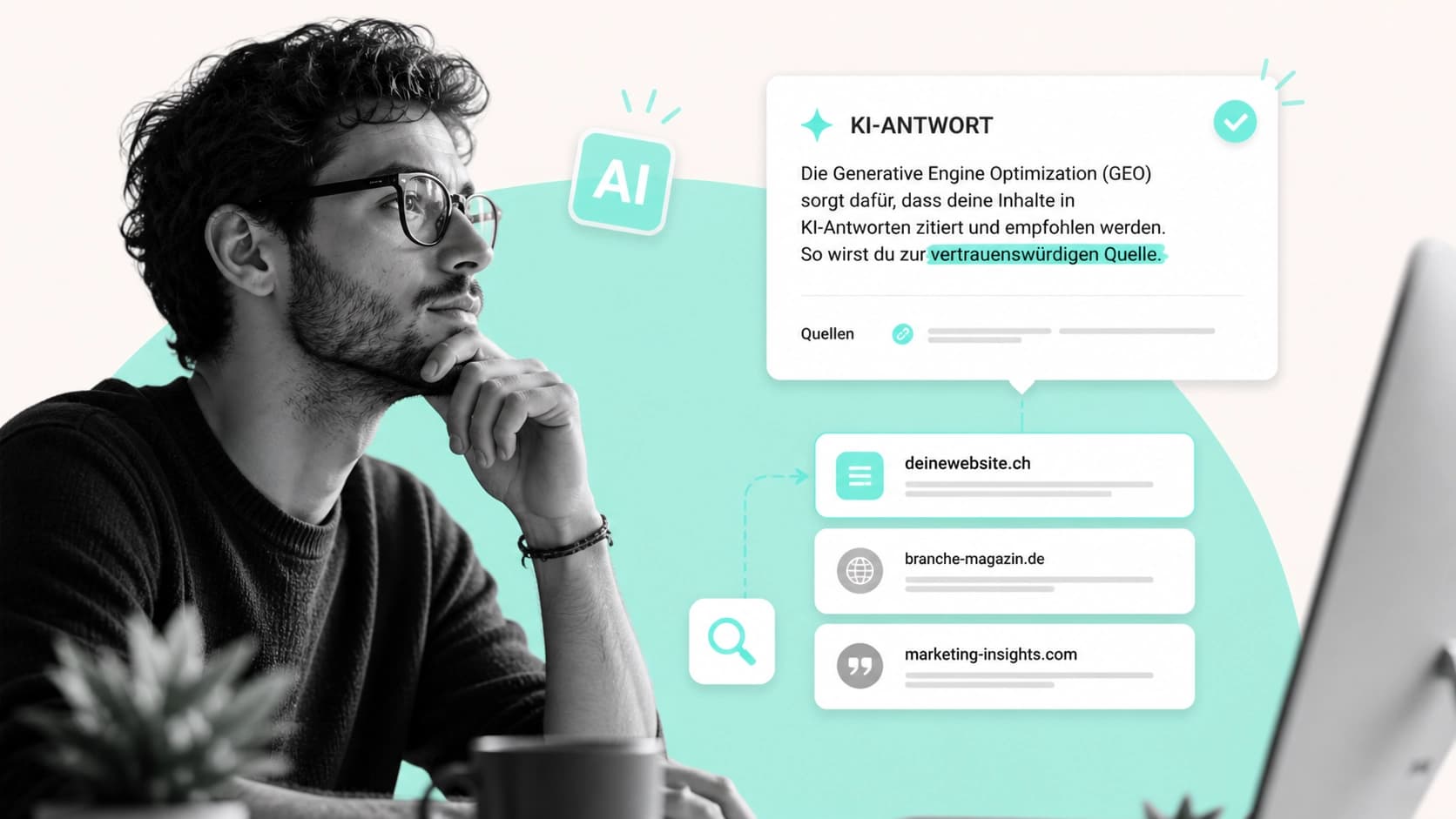
This is precisely the problem that Generative Engine Optimization (GEO) solves. GEO refers to the targeted optimisation of content so that AI systems such as ChatGPT, Google AI Overviews, Perplexity or Gemini recognise your company as a trustworthy source and cite it in their answers. It's not a replacement for SEO, but a necessary extension — for a world in which more and more search queries no longer lead to a list of blue links, but to a single, summarised answer.
For Swiss SMEs, GEO is still a genuine competitive advantage today, because only a fraction of companies have started with it. Those who act now build an authority position that will pay off in AI search for years to come. Those who wait will have to catch up — against competitors who by then are already established as sources in the training data and citation databases of AI systems.
What GEO means and why the term has caught on
The term Generative Engine Optimization was coined in 2023 through a research paper by scientists from Princeton University and the Georgia Institute of Technology, and presented at the international conference KDD 2024. The study systematically examined which content characteristics increase the likelihood of being cited in AI-generated answers — identifying measurable factors that go far beyond classic SEO logic.
Related terms have developed in parallel: LLMO (Large Language Model Optimization) emphasises the technical component of optimising for language models, while AEO (Answer Engine Optimization) focuses on direct answer boxes in classic search results. In the German-speaking market, GEO has become established as the umbrella term. In all cases, the goal is the same: making sure AI systems know your company, can classify it, and mention it for relevant queries.
The core statement is simple but far-reaching: generative engines make editorial decisions. They choose whom to cite and whom not to. This decision is not based primarily on Google ranking, but on factors such as credibility, clarity, data richness and semantic precision. The goal of GEO is therefore no longer «position 1 on Google», but «being part of the AI answer». The new currency isn't the click — it's the mention.
Klassisch
SEO
Neu & nötig
GEO
65%
Korrelation zwischen Google Top-10 und KI-Erwähnung
800 Mio.
Wöchentliche ChatGPT-Nutzer (Okt. 2025)
Why this shift matters right now
The speed at which AI search is complementing classic web search is remarkable. According to Semrush, ChatGPT reached around 800 million weekly users in October 2025 — double the figure from February of the same year. Perplexity processed around 230 million search queries per month at the end of 2024, growing to 780 million by mid-2025. Google AI Overviews appear in at least 13 percent of all search queries and in more than 50 percent of all informational queries.
What these figures mean for businesses was summed up succinctly by a HubSpot analysis: when an AI summary appears, the click-through rate on classic organic results drops by more than 50 percent. Gartner expects traditional search volume to decline by up to 25 percent by 2026. Semrush forecasts that traffic from LLMs will overtake classic Google traffic by the end of 2028.
For B2B decision-makers in Switzerland, there's another factor: B2B purchasing decisions today involve longer research phases, in which AI tools increasingly serve as the first point of contact. Those who don't appear at these early stages don't reach potential customers at all — regardless of how strong their classic SEO rankings are.
«Visibility in 2026 means being cited by AI as a source. The classic click on a search result is becoming rarer. Google AI Overviews, ChatGPT Search and Perplexity deliver the answer directly in search — often without the user ever visiting a website.»
— Analysis on Marketing Trends 2026, digitalmarketing.gmbh
The Swiss SME landscape has a particular starting position here. The market is manageable, purchasing power is high, and competitive density in many niches is markedly lower than in Germany or Austria. Those who establish themselves now as an authoritative source for a clearly defined niche in AI systems benefit disproportionately — because AI answers for local or specific queries favour a clear profile rather than simply naming the best-known global providers.
How AI systems technically decide who they cite
Anyone who wants to take GEO seriously needs to understand how generative AI systems work under the hood. They are not classic search engines that output a ranked list of websites. Instead, systems such as ChatGPT with web access, Perplexity or Google AI Overviews use a method called Retrieval Augmented Generation (RAG).
RAG works in several steps. First, the system translates the user query into a search vector and retrieves relevant text passages from the web or from a pre-indexed database. These passages are passed to the language model as context. The model assesses which passages best answer the query and synthesises a coherent answer from them — often without making all sources visible.
What's crucial: the model draws on individual paragraphs or sentences, not entire pages. A page with good content that is poorly structured or hard to extract loses out to a page with slightly less content but clearer, more modular formatting. According to the Princeton research, LLMs (Large Language Models) favour content that:
is backed by statistical data — up to 33.9 percent more visibility,
includes expert quotes — up to 32 percent higher citation likelihood,
is written in clear, fluent language — up to a 30 percent improvement,
references authoritative external sources — up to a 30 percent credibility boost.
There's also an often underestimated factor: the so-called popularity bias. LLMs have a bias towards well-known brands in their training data. Brands frequently mentioned in trade articles, news sources and industry directories receive statistically more weight. This doesn't mean small companies have no chance — but it does mean that mentions outside your own website are at least as important for GEO as your own site itself. Digital PR is the new link building.
Another technical lever is entity recognition. AI models don't just work with keywords, but with entities: clearly defined concepts, places, people and companies that the model can unambiguously identify. Companies that consistently use specific, recognisable entities on their pages — «marketing agency for Swiss SMEs in B2B mechanical engineering» instead of «we help companies grow» — provide the model with the semantic material it needs for precise classification.
According to an analysis by the Swiss SEO expert sh-digital.ch, this effect also shows up in regional tests: when asked «What is the best SEO agency in Switzerland?», ChatGPT doesn't name the agencies with the best on-page optimisation, but those with the greatest brand awareness in the training data. Companies present in trade articles, industry directories and media have greater statistical weight in the model — and appear correspondingly more often in answers.
GEO and SEO: not either-or, but one system
A widespread misconception is that GEO replaces SEO. That's demonstrably wrong. Semrush analyses show a 65 percent correlation between classic Google page-1 rankings and mentions in AI answers. Companies with strong Google positions have a significantly better starting point for GEO. Without a solid SEO foundation, there is no successful GEO.
The difference lies in the optimisation goal and the success metrics. SEO optimises for the Google algorithm, which decides which pages appear in which order in the SERP. GEO optimises for the language model, which decides which content passages are used in a synthesised answer. SEO measures click-through rates, rankings and organic traffic. GEO measures AI share of voice, citation rate and brand presence in AI answers.
Combining both disciplines secures digital visibility in two worlds at once: in classic search results and in AI-generated answers, which increasingly determine the first impression of a company. The effort required for GEO is manageable, since many measures overlap with good SEO practice. Clear structures, sourced evidence, genuine expertise and technically clean pages — that has always been good SEO, and it's also the foundation of GEO.
The five levers of GEO optimisation — concrete and actionable
GEO doesn't consist of a single trick, but of a bundle of coordinated measures. For Swiss SMEs, five practical levers can be identified that can be implemented without specialist technical knowledge and deliver measurable results.
Lever 1: structure content like a news agency
AI systems extract information from texts sequentially. If the most important statement only appears in the sixth paragraph, it may be skipped or not correctly matched to the topic. The solution comes from journalism: the «inverted pyramid». The most important information goes right at the top, with details following afterwards.
In GEO practice, this means: every important page begins with a core paragraph of 40 to 80 words that fully answers the central question. Someone googling or asking «What does a social media agency cost in Switzerland?» should find this answer immediately — not only after three introductory paragraphs. According to a 2025 seoClarity analysis, the typical passages cited in Google AI Overviews became progressively shorter over the course of the year. Precise, compact core paragraphs are favoured.
The H-hierarchy (H1 to H3) serves as an orientation structure for the AI system: it signals which sections belong together and which questions are addressed. Tables, ordered lists and clearly named subheadings help the model extract and correctly assign relevant sections. According to HubSpot research data, LLMs cite content with clear formatting 28 to 40 percent more often than poorly structured texts.
Lever 2: E-E-A-T as a core principle, not a checklist
Google's E-E-A-T principle (Expertise, Experience, Authoritativeness, Trustworthiness) is even more important for GEO than for classic SEO. AI systems favour sources that are demonstrably competent. In practice, this means no articles credited to «Team» or «Admin», but author profiles with real names, verifiable qualifications and linked credentials.
For a Swiss SME, this can be applied concretely: who in your company is the expert on which topic? A communications consultant from Bern who writes under her full name about crisis communication for SMEs and cites 12 years of experience with Swiss mid-sized companies is more convincing to an AI system than an anonymous company blog.
The E-E-A-T foundation also includes transparency about your own data and methods. Claiming «most of our clients achieve better results with our method» gives the model nothing usable. Writing: «In an evaluation of 47 SME projects in the B2B content field from 2023 to 2025, it emerged that...» offers the model a citable, verifiable statement. Original studies, case figures and experience-based data are the strongest currency in a GEO context.
Lever 3: question-based content that meets real search intent
Users ask AI systems conversational, often very specific questions. Instead of «agency Zürich», someone asks: «Which marketing agency is suitable for a B2B company with 20 employees in German-speaking Switzerland that mainly operates in mechanical engineering?» This type of long-tail query is increasing. According to HubSpot, AI search queries average 23 words — compared with around 4 words for classic Google queries.
Content tailored to such queries needs to use W-questions as headings («What does... cost», «How long does... take», «Which agencies...»), formulate answers in direct language, and back them up with concrete figures. FAQ sections are particularly valuable here: they mirror exactly the format in which users query AI systems, and, according to HubSpot statistics, have the highest citation rate of all content formats.
For the Swiss market, it also applies: CHF figures instead of EUR, Swiss examples from Zürich, Basel or Bern, references to local specifics such as multilingualism (DE/FR/IT), revFADP compliance or regional industries (fintech, medtech, machine industry, watchmaking). According to the Swiss SEO consultant werank.ch, AI assistants are increasingly personalising their answers regionally — those who position themselves clearly at a local level have a structural advantage over providers without a regional focus.
Lever 4: technical GEO foundations
Without a clean technical foundation, good content doesn't reliably end up in AI answers. Several factors are decisive.
Schema markup: JSON-LD implementations of FAQPage, HowTo, Article and LocalBusiness help AI crawlers to correctly categorise content and clearly assign entities. FAQPage schema is particularly effective because it structures questions and answers in a machine-readable way — exactly the format AI systems favour when generating answers.
Core Web Vitals: AI crawlers prioritise fast-loading pages. Sites with server response times over two seconds are crawled fully less often. Compressed images, minified JavaScript and a clean caching setup are therefore not just relevant to SEO, but directly relevant to GEO.
Clean HTML structure: JavaScript-dependent content that only renders in the browser isn't read by many AI crawlers. Content not visible in raw HTML doesn't exist for the system. Those who store important text content in JavaScript components should check server-side rendering.
Consistent entity data: name, address and phone number (NAP) must be identical across your own website, Google Business Profile, local.ch, search.ch and other directories. Inconsistent entries reduce brand trustworthiness in the eyes of the AI system — because the model can't reliably determine whether it's the same company.
Lever 5: build external mentions as a citation foundation
The most surprising finding from Ahrefs' research: when analysing which pages ChatGPT, Google AI Overviews and Perplexity used for mentions of the Ahrefs brand, the cited content predominantly came from third-party sites — not from ahrefs.com itself. In many cases, the company's own website wasn't even among the top sources.
This means: mentions outside your own website aren't just a nice bonus — they're the primary lever for citations in AI answers. For Swiss SMEs, this can be tackled concretely:
Complete entries in industry directories: local.ch, search.ch, chamber of commerce directories, industry-specific portals.
Guest contributions in trade media: Handelszeitung, kmu.org, Swissmem publications, regional business magazines.
Positions in «Top X» lists: articles such as «The 10 best social media agencies in Switzerland» are primary citation sources for AI systems.
Mentions in podcasts and on YouTube: according to a HubSpot statistic, YouTube is the most-cited content platform in AI answers — transcripts of video interviews or podcast episodes are therefore valuable for GEO.
PR in regional media: coverage in NZZ, Tages-Anzeiger, Berner Zeitung or local business media generates authority signals that the AI model factors in when evaluating a brand.
How GEO plays out the local advantage for Swiss SMEs
AI assistants are increasingly personalising answers according to geographic signals. Companies offering a service in Zürich, Basel or Bern and clearly communicating that locality in their content have a structural advantage over national or international providers — because the AI system favours the geographically closer, clearly positioned source for queries with a local reference.
In practice, this means: mention your location explicitly in the content, not just on the contact page. Case studies with client names and locations, where this can be shown in a data-protection-compliant way. Work in local specifics that international AI answers can't take for granted — trilingualism (DE/FR/IT) in Swiss communication, revFADP compliance as a requirement, features of the Swiss labour market, or regional industry structures such as the watchmaking industry in the Jura or the medtech cluster in central Switzerland.
The same principle applies to Google Business Profile: the profile is a primary data source for AI systems for local queries. Complete, up-to-date information about categories, description and regular reviews with responses increase the likelihood of appearing in a localised AI answer.
Competition in the Swiss market is still manageable. According to Xictron, around 47 percent of companies still don't have a GEO strategy. In the Swiss SME segment, this share is likely even higher. The window of opportunity is open — but limited.
Measuring GEO success: what counts and how to track it
This is the point where many SMEs hesitate — because GEO success is harder to measure than a classic keyword ranking. There's no rank position in ChatGPT. But there are meaningful indicators that can be observed even without expensive specialist software.
Manual monitoring: simple and immediately actionable
The most direct approach is manual testing: ask ChatGPT, Perplexity and Google AI Overviews targeted questions for which your company would be a relevant answer. Set up a document or table, repeat the questions weekly, note the results. Does your company name appear? Is your URL cited? Which competitors show up? What phrasing is used in the answers?
This method is free, takes 15 minutes a week, and provides immediate insight into how your own company is positioned in AI perception. It also shows which competitors are already running GEO measures — and gives clues about which content types and phrasing are actually cited.
Tools for systematic monitoring
HubSpot's AI Search Grader is free to use and provides an initial assessment of brand presence in ChatGPT, Perplexity and Gemini — including sentiment analysis and comparison with competitors. Well suited for getting started, with no ongoing costs.
For continuous monitoring there is Otterly.AI (from around CHF 25 per month), which regularly sends defined prompts to AI systems and tracks mentions. Semrush's AI Visibility Toolkit and Ahrefs Brand Radar offer deeper analyses for teams pursuing GEO strategically. As a rule of thumb, experts suggest budgeting an additional 10 to 20 percent of the existing SEO budget for GEO measures.
Traffic signals in Analytics and Search Console
Referral traffic from AI platforms can be observed in Google Analytics or Matomo (a privacy-friendly alternative for Swiss companies). This channel grew massively in 2025: according to HubSpot data, by 600 percent year on year. Anyone not yet analysing this segment separately can't assess which pages AI systems favour.
Alongside direct AI referral traffic, growth in branded search (users searching directly for the company name) also counts as an indirect GEO signal. When ChatGPT mentions your company in an answer without linking directly, interested people often go straight to Google and search for the name — which shows up in the branded search curve. Similarly, direct traffic often rises in this scenario, since users know the URL or recall it from memory.
Common mistakes that hold back GEO success
GEO is a young field, and accordingly, plenty of half-truths circulate. Three mistakes are especially common in practice.
Keyword stuffing for AI
Some try to saturate texts with «AI-friendly» phrases, hoping to be cited more often as a result. That doesn't work. AI systems recognise unnatural language patterns and prioritise naturally worded, information-rich text. The right approach isn't more mentions of the keyword, but more substantial information on the topic — fact-based, sourced, clearly structured.
Mass production instead of depth
Ten superficial articles achieve less for GEO than a single, thoroughly researched and clearly structured article on the same topic. According to Clearscope research, comprehensive content with more than 2,500 words and broad topical coverage receives 3.2 times more AI citations than shorter, superficial content. Quality beats quantity even more clearly in a GEO context than in classic SEO.
Treating GEO as a one-off measure
GEO isn't a project with a completion date. AI systems continuously update their indices, new platforms emerge, and algorithms change. Companies that optimise content once and then do nothing for six months lose ground to competitors who continuously publish new, current content. Freshness is a relevant quality signal for AI systems — outdated statistics or pricing without an update date are cited less often than fresh content. Consistently updating core pages at least every six months pays off.
Practical tip: Ask ChatGPT once a week about your core service plus location — for example, «Which communications agency do you recommend for an SME in Bern?» — and document the answers in a simple table. In your editorial calendar, add an update date to every article and revise older content with new figures at least every six months. This costs little time and keeps content fresh for AI crawls.
ChatGPT-Nutzer
0 Mio.
wöchentlich (Okt. 25)
Google AI Overviews
0%
aller Suchanfragen
KI-Referral-Traffic
0%
Wachstum 2025
KMU ohne GEO
0%
noch keine Strategie
KI-Nutzer-Wachstum 2024–2025
Wöchentliche aktive Nutzer in Millionen
GEO checklist: immediately actionable first steps
GEO sounds like yet another complicated marketing concept that eats up a lot of time and budget. In practice, getting started is manageable. The following checklist helps Swiss SMEs get concrete right away — without a specialist agency and without a large budget. Anyone who then wants to find a suitable agency can do so directly via the mmesh Briefing process.
Assess the current state: ask ChatGPT, Perplexity and Google relevant questions and document whether your own company appears.
Add core paragraphs: check the five most important pages on the website. If the central statement isn't in the first two sentences, rewrite it — inverted pyramid.
Build an FAQ section: add at least five real customer questions with direct answers to every important service page. Implement FAQPage schema in JSON-LD format.
Complete author profiles: add a real author name, area of expertise and a sentence about professional experience to every blog article. Add a LinkedIn link.
Check industry directories: check entries on local.ch, search.ch and Google Business Profile for completeness and consistency. NAP data must be identical everywhere.
Back up claims with external sources: include at least two links to official Swiss sources in every article — FSO, SECO, industry associations, chambers of commerce. This signals trustworthiness.
Set up monitoring: use HubSpot AI Search Grader for free to establish a baseline. Alternatively: document weekly manual prompt testing in a table.
Adjust the content calendar: plan at least one topic per month from the perspective of «What does someone ask who doesn't yet know a solution?» and formulate it as a W-question heading.
These eight measures can be implemented within a few days and lay the foundation for GEO effectiveness. The rest — deeper schema markup, systematic monitoring, building mentions in trade media — comes afterwards, once initial results become visible.
An observation from mmesh practice: analysis of more than 200 Swiss provider profiles on the platform shows that companies with complete, structured service descriptions — including industry focus, location details and concrete service features — appear significantly more often in test queries on ChatGPT and Perplexity than providers with generic short texts. The difference doesn't lie in budget, but in content precision. This aligns with the recommendations from the Princeton research: entities must be clearly defined and semantically unambiguous so that a language model can reliably classify them.
Which agencies help with building GEO?
GEO is a new discipline. Not every agency with SEO in its portfolio also masters GEO. When choosing one, it's worth asking directly: which measures are recommended for AI visibility? How is success measured? Are there reference projects from the German-speaking market?
Good GEO work is based on a combination of content expertise, technical SEO knowledge and PR skills — because external mentions are a key success factor. An agency offering only on-page SEO won't be enough for GEO. An agency that combines content production, schema markup and media work is much better positioned. Those who also run paid search campaigns at the same time can build GEO and performance marketing as complementary channels.